2015 York Christian Apocrypha: A Postmortem (Part 3)
Part of the mandate of the Symposium series, from its start, is to respond to the widespread interest in the Christian Apocrypha and reach out to the wider public. Indeed, that’s why also we publish the proceedings with Cascade, so that we can keep the price of the volumes relatively low. And that’s why we began the series in 2011 with the Secret Gospel of Mark, a text somewhat well-known outside of scholarly publications. Our efforts to bring in non-scholars included scheduling an evening session featuring a panel of four Secret Mark scholars (Scott Brown, Craig Evans, Peter Jeffery, and Marvin Meyer) for an informal Q and A session. The session was promoted off-campus with flyers to local libraries and a media package sent to local radio and newspapers. Anticipating a strong response, we booked a large lecture hall; we were disheartened to see that perhaps only a handful of people attended the event (above and beyond those who were present also throughout the day). The low turnout can be attributed, to some extent, to York’s location—the campus is situated north of the city and can be intimidating to navigate for outsiders. Schedule an event downtown and the situation would be very different.
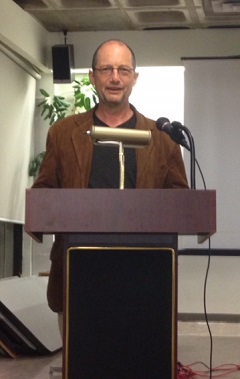
In 2013 we changed tactics somewhat and asked Annette Yoshiko Reed to deliver a keynote address. The tone of the 2013 Symposium was more scholarly (it was a “state-of-the-art” for CA research in North America), so we did not try to promote the event off-campus. But surely things would be different with Bart Ehrman, a well-known public speaker whose appearances in the US draw in audiences in the hundreds. Also, Ehrman had not spoken in Canada for almost ten years, so surely the demand to see him would be high. It was a great opportunity to once again reach out to the wider community with flyers and media packages. Alas, the media did not come calling and we ended up with only a handful of outsiders. Curse you, York!
Once we settled on the theme of the 2015 event (“Facts, Fictions, Forgeries”), Bart Ehrman seemed to be the perfect fit as our keynote speaker, since he had recently published two books on forgery in antiquity: his scholarly monograph Forgery and Counterforgery: The Use of Literary Deceit in Early Christian Polemics (New York: Oxford University Press, 2013) and its popular-market counterpart, Forged: Writing in the Name of God—Why the Bible’s Authors Are Not Who We Think They Are (San Francisco: Harper Collins, 2011). Brent Landau was tasked to contact Ehrman and see if he was willing to participate. I thought it was a longshot, given Ehrman’s busy schedule and the size of our event (chalk it up to Canadian confidence-deficiency). To our surprise, Ehrman accepted but requested his usual speaking fee of $5000—which he donates to charity. I asked my department for financial support but the cost was simply too high. I began to consider other options for a keynote speaker, but then Ehrman said he would waive the fee. We were delighted.
I met Ehrman back in 2007 after the publication of the National Geographic Society’s popular-market book on the Gospel of Judas, which features an essay by Ehrman entitled “Christianity Turned on Its Head: The Alternative Vision of the Gospel of Judas.” The Canadian Congress of the Humanities (a gathering of all Canadian academic associations) was meeting at York that year and the Canadian Society of Patristic Studies (in partnership with the Canadian Society of Biblical Studies) brought in Ehrman as the speaker for their Craigie Lecture Series. I was the local representative for CSBS and was asked by the CSPS executive to join them for a pre-lecture dinner with Ehrman. I was a big fan of Ehrman’s work, particularly his break-out monograph The Orthodox Corruption of Scripture. His popularization of that book, Misquoting Jesus, had been released just a few years earlier and he was riding a crest of popularity. So I made sure I sat close to Ehrman at dinner and we talked Christian Apocrypha long into the night (well, for an hour-or-so anyway). Ehrman’s lecture was booked for a large lecture hall on campus and it was filled to capacity (the CSPS is a rather small group but the lecture drew in members of other societies also). In years since I have run into Ehrman from time-to-time at SBL and we sat on a panel together in 2014 on writing apocrypha for popular audiences.
Ehrman is often criticized for his popular work, both by conservatives who object to his positions on the instability of the text of the New Testament and on his support of the Bauer Thesis, and by liberals who object to his simplification of complex issues. Nevertheless, he commands a certain amount of respect and awe, and his presence at the symposium brought palpable energy to the entire event.
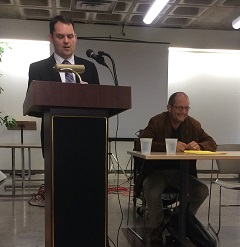
I volunteered to introduce Ehrman and chair the Q and A session that followed. I began with a confession that I was a Bart Ehrman “fanboy,” that I had followed his work from the start, before he became popular and “sold out”—I was no johnny-come-lately who just knew the hits. I noted his various popular books, his work on Christian Apocrypha, and his appearances in the media, and mentioned his return to scholarly monographs with Forgery and Counterforgery. I characterized the book as a call to dispense with the common view that pseudepigraphical NT texts (and noncanonical texts, but readers are far less reluctant to think of apocrypha as “forgeries”) are forgivable as “pious frauds” or as a common phenomenon in antiquity of “writing in the school” of a venerated figure. Ehrman was not afraid to call a spade a spade, I said.
Ehrman began by stating that he was happy to be among scholars at the Symposium because most of his appearances involve debates with theologians in front of hostile audiences. The aim of his lecture was to discount the view of the Jesus Seminar and like-minded scholars that plagiarism did not exist in antiquity. He proposed universal taxonomy of forgery, ranging from pseudepigraphy, to falsification (including additions to texts, such as Luke’s bloody sweat), to fabrication (representing historical events that are fictions), to literary fictions and plagiarism (and probably a few more categories that I missed). Ehrman’s key point, as stated in Forgery and Counterforgery, is that “Forgery was not an acceptable practice in the ancient world, any more than other forms of lying and deception were acceptable practices” (p. 132).
Ehrman’s assumption that a scholarly audience would be more receptive to his ideas than his usual audiences was challenged immediately after his lecture by Phil Harland, my York colleague and long-time friend. Harland pulled no punches with his questioning of Ehrman’s “value-laden” terminology; he accused Ehrman of not acting as a responsible historian by taking sides in calling the texts “lies” and “deceptions.” In response, Ehrman said that he was not attaching value to the terminology at all—a lie can be told for good reason, but it is still a lie, and a writer putting someone else’s name on a text is certainly deceptive. He countered also that he can find no-one in antiquity who writes in support of the practice, including Christian writers. The exchange was quite heated, with Harland frequently cutting Ehrman off before he could finish his responses. At one point I was prepared to step in and put an end to the argument but Ehrman has had plenty of experience dealing with his critics and deftly moved on to another question.
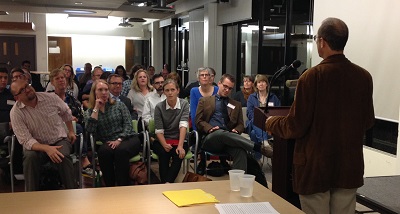
Pierluigi Piovanelli, who had entered into a much more genial exchange with Ehrman earlier in the day, raised another objection to Ehrman’s typology by citing inspiration—i.e., the writers do not see themselves as being deceptive, instead they believe they are inspired to write in others’ names. Both Harland and Piovanelli, if I understand correctly, are advocating a religious studies approach to the phenomena in an attempt to understand the motivation behind the production of this literature without placing judgement. Ehrman, for his part, focuses on the original context for the texts, to, again, refute modern scholarship’s pervasive assumption that plagiarism did not exist in antiquity. It certainly did and it was universally condemned. I suspect the two sides (Ehrman and Piovanelli/Harland) in this discussion are not so far apart from one another but, as discussed in conversation later that night, Ehrman speaks very much in the style of a preacher, forcefully arguing his case against an imagined fundamentalist straw man. So the perceived moral indignation against forgery is more in Ehrman’s tone and rhetoric than in the contents of his arguments.
The evening finished with a gathering at a nearby campus pub. In that more relaxed setting, I asked Ehrman how he felt about Harland’s grilling. He saw it as nothing more than a discussion between two scholars. Over the course of the following day Ehrman told me several times how much he had enjoyed the Symposium, saying that he “really likes coming to these little conferences.” How gracious! Is it any wonder why I’m such an Ehrman fanboy?
Tobe concluded…
P.S. For James McGrath’s detailed summary and commentary on Ehrman’s keynote address see HERE.