Skip to content

Apocryphicity

  • About
  • Tony Burke’s Homepage
  • Contact Tony

Apocryphicity

A Blog Devoted to the Study of Christian Apocrypha

Editing More Christian Apocrypha, Part 3: It Takes a Village

February 28, 2019 by Tony

Years ago, way back in 2006, a group of North American Christian apocrypha scholars gathered in Ottawa to discuss, among other things, the creation of a collaborative project that would show the world that we (i.e., North Americans) had contributions to make to the field. We wanted to create something on the scale of the great European apocrypha collections, such as the two-volume Écrits apocryphes chrétiens or the highly-regarded Hennecke-Schneemelcher (now Markschies-Schröter) Neutestamentliche Apocryphen volumes. Nothing concrete came out of that discussion but it was the germ for the MNTA project that Brent Landau and I took on several years later, and the same desire to create opportunities for collaboration among North American scholars was behind the creation of the York University Christian Apocrypha Symposium Series (running from 2011 to 2015) and the creation of the North American Society for the Study of Christian Apocryphal Literature (NASSCAL). It struck me recently, as I finished up (most of the) work on MNTA 2, how far we have come in realizing that ambition of bringing scholars together, not only for formal, co-authored projects but also for informal, behind-the scenes consultation to make each other’s work better, to mentor students and young scholars, and to advance the study of these fascinating texts.

One of the difficulties of working with apocryphal texts is that the texts come in numerous forms, in multiple languages. We are all trained in at least one ancient language (typically Greek), many of us two (add Latin, Coptic, or Syriac), …
Continue Reading

Editing More Christian Apocrypha, Part 2: Advice for Young Scholars

October 13, 2018 by Tony

This past Spring I sat on a panel for students at the Canadian Society of Biblical Studies annual meeting entitled “Review, Respond, Reflect.” I was asked to discuss my experiences editing the work of other scholars. I included some tales (many of which were cautionary) from my experience editing the two MNTA volumes, as well as from my other editing projects: the three York University Christian Apocrypha Symposium collections, and Rediscovering the Apocryphal Continent (co-edited with Pierluigi Piovanelli).I thought it might be useful to include the advice I gave to the students and young scholars in this short series of posts on editing MNTA vol. 2. My comments were somewhat candid, so I won’t repeat them all here (and even so I’m a little worried that what I do say could offend some).

1. To edit or not to edit

When my colleagues ask me what I’m working on and I tell them about editing projects, they respond with pity and some statement along the lines of “better you than me.” Edited volumes are universally (throughout the scholarly world, not just in Religious Studies and related disciplines) considered unpleasant and extremely frustrating experiences that come with little reward, because most universities don’t count assign them much weight in their calculations for tenure and promotion. I contend, however, that they do have value.

For grad students or junior scholars the first exposure to editing likely would come from working with an advisor or colleague on indexing a volume. This is considered …

Continue Reading

Editing More New Testament Apocrypha, Part 1: Choosing the Texts

December 26, 2018 by Tony

Yesterday I sent off the last chapter of New Testament Apocrypha: More Noncanonical Scriptures vol. 2 (=MNTA 2) to its authors for revisions. The project is not over by a longshot, but it is the end of a major stage in the process of getting this volume, now over three years in the making, to publication.  Of the 36 texts included in the volume, 29 are complete, four are in the authors’ hands waiting for final revisions, and the last three are contributions by the editors (Brent Landau and I)—these always get delayed until the very end. This seems to me a good time to pause and look back at how the project came together.

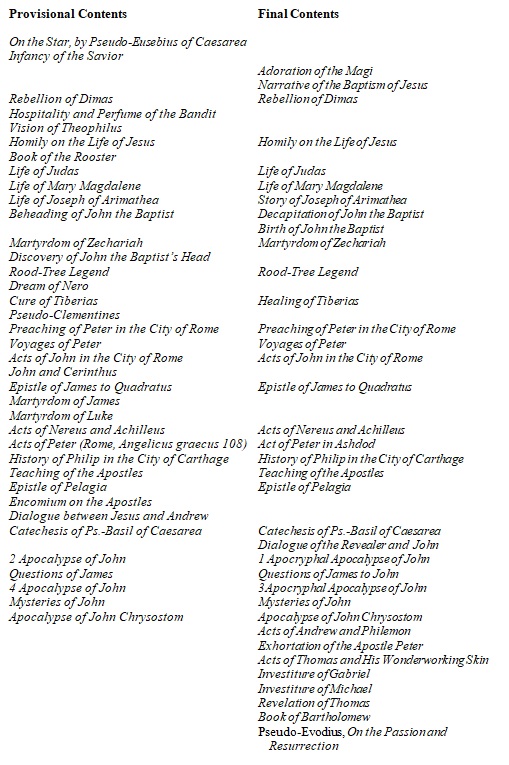
The planning for this volume began when  we submitted the manuscript of vol. 1 to the publisher back in January 2015 (yes, that long ago). The introduction included a provisional list of texts to be included in vol. 2. As you can see below, that list was provisional indeed.

Why so many changes? Well, some are not that dramatic at all and are merely changes in titles. But some texts are absent from the final contents because these projects were just too big and our contributors simply realized at some point that they could not finish it in time for our deadline. This was certainly the case for the Infancy of the Savior and the Vision of Theophilus (both of which I promised to contribute), and the other major work was the Pseudo-Clementines, …

Continue Reading

Johannine Apocalyptica in Church Slavonic

September 27, 2018 by Tony

For the second volume of New Testament Apocrypha: More Noncanonical Scriptures I decided to include as much information as possible on what we call “versions”—a term designating translations of the texts into other languages. Such attention is a given if the text is not available in its original language, but far too often in Christian apocrypha scholarship there is a neglect of those languages outside of Greek and Latin, and perhaps Coptic and Syriac, that few of us can claim some proficiency. One of these neglected language groups is Church Slavonic (CS). There are plenty of experts in Slavistics, and some work on Jewish and Christian apocrypha, but there seems to be little interaction between the two groups of scholars. Unfortunately, I have no training in the language nor its history but I am working on some texts for MNTA that are plentiful in CS manuscripts. So this past weekend I went to work with my frequent research partner Slavomír Céplö (whose language knowledge is enviable) to fill in the details about the CS tradition of four apocryphal Johannine apocalypses. The work was fruitful but frequently frustrating.

First, a little background on the texts. I described many of them in a previous post on erotapokriseis (question-and-answer) literature, but I will give some brief details here also. 1 Apocryphal Apocalypse of John, the most well-known of the texts, is a sequel of sorts to the canonical Revelation. Jesus appears to John on Mount Tabor and John asks him a …

Continue Reading

The Stoning of the Devil (Ramy al-Jamarat) in Coptic Christian Apocrypha

August 17, 2018 by Tony

Two Coptic Christian texts to be included in the second volume of New Testament Apocrypha: More Noncanonical Scriptures (edited by me and Brent Landau) allude, perhaps, to the Ramy al-Jamarat, a ritual performed by Muslims during the Hajj pilgrimage that involves throwing stones at the devil. If indeed the writers of these Christian apocrypha are aware of the ritual, then these texts illustrate Muslim-Christian interaction in Egypt and perhaps open up questions about pre-Islamic origins of the ritual.

The longest version of the account appears in a fragmentary text sometimes referred to as the Homily on the Life of Jesus and His Love for the Apostles. Some scholars believe the lost beginning includes an attribution to Evodius, the successor of Peter as bishop of Antioch, but in Coptic Christianity he is considered the second bishop of Rome. The text has been reconstructed on the basis of three manuscripts, all dated to the tenth century and deriving from the White Monastery. Today the pages of these manuscripts are dispersed among various European collections. Timothy Pettipiece has prepared a translation for MNTA 2, the first complete translation of the text in English. The text retells certain stories from the Gospels—the multiplication of the loaves and fishes, the raising of Lazarus, and Peter’s confession at Caesarea Philippi—but with significant expansions. Between these stories are weaved three new episodes: an effort to make Jesus king of Judea (inspired by John 6:15), the apostles’ encounter with the devil and his demons disguised as fishermen, …

Continue Reading

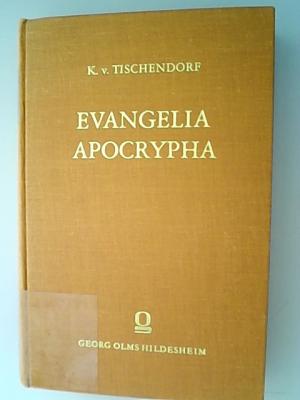
A full-text edition of Tischendorf’s Evangelia Apocrypha

August 6, 2018 by Tony

Tischendorf’s Evangelia Apocrypha is a text that virtually everyone who works in Christian Apocrypha has dealt with at one point or another. It isn’t overly difficult to find in print, most decent academic libraries will have a copy, and several different PDF editions are even available on archive.org. The PDF editions, however, are basically pictures of pages.

What if there was a high-quality full-text edition of Tischendorf’s Evangelia Apocrypha available? Not just available, but openly available for scholars to use in whatever research or digital humanities projects they were involved in? And not just the Latin and Greek text, but the apparatuses too?

We’re closer to that than we have ever been. If you’ve worked with Evangelia Apocrypha, you know that the Greek text uses a distinctive font. This font makes optical character recognition (OCR) difficult because it isn’t like other Greek fonts. However, Bruce Robertson of Mount Allison University in New Brunswick has been working on the problem of Greek OCR (see his project Heml, Historic Event Markup and Linking) and wanted to try and OCR this volume. Rick Brannan provided him some training data based on Rick’s corrected transcription of Tischendorf’s Acts of Pilate A, and Bruce loaded it up in his environment.

The result is now available in Bruce’s Greek OCR Challenge. The interface places the page scan on the left and the OCR’d text on the right. It allows for relatively pain free correction of the OCR’d material. You can see (and …

Continue Reading

On Byzantine Apocrypha and Erotapokriseis Literature

February 28, 2019 by Tony

As I work through the contributions to the second volume of New Testament Apocrypha: More Noncanonical Scriptures, I am struck by how many of them are related to a genre of literature that has not been discussed much in connection with apocryphal texts. This genre is erotapokriseis (question-and-answer) texts. For an introduction to this literature, see Péter Tóth, “New Wine in Old Wineskin: Byzantine Reuses of the Apocryphal Revelation Dialogue,” in Dialogues and Debates from Late Antiquity to Late Byzantium (ed. Averil Cameron and Niels Gaul; New York: Routledge, 2017), 77–93 (available on academia.edu) and Yannis Papadoyannakis, “Instruction by Question and Answer: The Case of Late Antique and Byzantine Erotapokriseis,” in Greek Literature in Late Antiquity: Dynamism, Didacticism, Classicism (ed. Scott Fitzgerald Johnson; London/New York: Routledge, 2006), 91–105 (also online HERE).

The genre can be defined widely enough to include any dialogue literature, going as far back as Pseudo-Aristotle’s Problemata (compiled over a period stretching from 300 BCE to 600 CE) and, in their early form, are structured as an exchange between a master and his disciples. This should be familiar to readers of such apocryphal texts as the Dialogue of the Savior and the Letter of Peter to Philip, in which a (typically) post-Easter Jesus responds to a series of questions from his disciples. Kurt Rudolph called these texts “apocryphal revelation dialogues,” Helmut Koester, more provocatively, “dialogue-gospels.” The prevalence of the form among the so-called “gnostic” texts of the Nag Hammadi Library led to …

Continue Reading

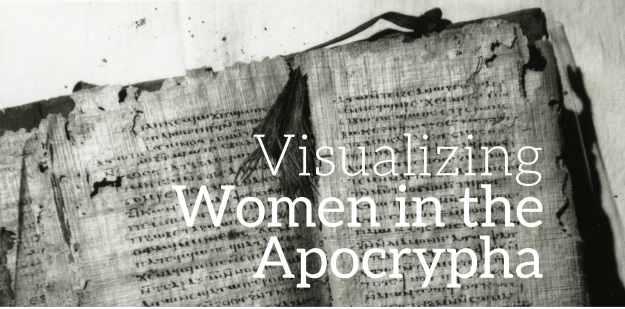
CFP: Visualizing Women in the Apocrypha

July 16, 2018 by Tony

Call for Papers for Special Session at the International Congress on Medieval Studies (ICMS 2019)

May 9 to 12, 2019

Western Michigan University

The proposed session is devoted to the construction and visualization of women as reflected in apocryphal sources with the aim of bringing into attention this generally neglected topic/sources which seem to be underrepresented. The existent literature, in the general field of apocrypha, indicates that there is space for debate on issues connected to gender in these sources.

Research in this field concentrates mostly on the textual tradition and transmission of apocryphal texts, yet aspects concerning the construction and function of women and gender still need to be addressed. Hence, we seek to examine issues related to the status, function, and identity of women who may be models and/or background figures in fields pertaining, but not limited to: theology, religious studies, textual studies, manuscript studies, art history in a transdisciplinary perspective.

Original work and research is welcomed starting from the Late Antiquity to the Late Middle Ages, both in the East and West. The sessions refer to the concept of ‘apocrypha/on’ as movable texts whose composition does not end in the fourth – fifth centuries in the context of the establishment and closing of the canon. This permits to address issues concerning the evolution, transmission, adoptation, and adaptation of sources.

This session also aims to bring the intellectual outcome of these sessions into the attention of the general public by publishing the proceedings of the debates in the …

Continue Reading

The Gnostic Pinocchio

July 8, 2018 by Tony

One of my tasks this summer was to complete a paper begun many years ago (I first presented it at the SBL Annual Meeting in 2003!). As I often do, I committed myself to finish the paper by agreeing to contribute it to a special volume of the journal Religious Studies and Theology in honor of my doktorvater Michel Desjardins, who recently retired. The origins of the paper go back to Michel’s 1995 Gnosticism class at Wilfrid Laurier University. He casually asked the class about analogues to the gnostic cosmogonies that would help readers understand and appreciate them. Eager to impress, I came up with the Pinocchio analogy and presented it to the class at our next meeting. I have used the parallels in my own Gnosticism classes ever since. Gnostic parallels to films are somewhat de rigueur these days, with lots of examples appearing in the past few decades (e.g., The Matrix, The Truman Show), but back in 2003 this one was somewhat novel and I have found that it works really well in my classes—it’s the one thing the students remember! What follows is a shortened version of the submitted paper (notes and citations have been removed also for ease of reading).

Disney famously said, “We just make the pictures, and let the professors tell us what they mean.” He was adamant about keeping religion out of his films. True to Disney’s word, except for occasional christening and wedding ceremonies, there are few explicit religious elements …

Continue Reading

2018 New Testament Apocrypha Course: Week 10

May 17, 2018 by Tony

My New Testament Apocrypha course finished up last week with a class focusing on two aims: a look at anti-gospels (i.e., texts written by non-Christians for non-Christians to either lampoon or criticize Christianity, or to recast Jesus for a new religious system) and modern apocrypha. We also participated in an online chat session discussing Philip Jenkins’ book The Many Faces of Christ, which the students had to read for their book review assignment. As mentioned in previous posts about the course, York University is currently embroiled in a labour dispute, so the course has been continuing as a combination of online video lectures (the latest can be seen HERE) and chat sessions.

I began the lecture on anti-gospels with a short discussion of Christian-Jewish conflict in the first few centuries. I covered Mark’s apocalyptic discourse warning of being “handed over to councils and beaten in the synagogues” (13:9-13), John’s parents of the blind man who worried about being cast out of the synagogue for confessing Jesus as the Christ (9:22-23), arrests and executions of apostles in Acts, Paul’s issues with Judaizers, and several sections of Matthew (his genealogy which seems to anticipate criticism of Jesus’ conception, the slander of the disciples stealing the body of Jesus [28:11-15], and the declaration “Let his blood be on us and on our children!” [27:25]). These led into a discussion of Celsus’ The True Word and of possible references to Jesus in the Talmud.

Finally I arrived at the Toledoth Yeshu (the …

Continue Reading

2018 New Testament Apocrypha Course: Week 9

May 7, 2018 by Tony

This week marked our final look at ancient Christian-authored apocrypha; our final class, in two weeks, focuses on anti-Christian apocrypha (the Toledot Yeshu and the Gospel of Barnabas) and, newly added this year, modern apocrypha. But this week we looked at tales of Mary, Joseph, John the Baptist, and Jesus’ wife Mary Magdalene (just joking).

Again, as a result of York’s labour disruption, I created a video lecture for this week’s class (which you can view HERE, if you wish). I began with a discussion of references to the family of Jesus in patristic literature: the names of Jesus’ sisters according to Epiphanius, traditions about the death of James, and Hegesippus (via Eusebius) on the grandsons of Jude and Jesus’ cousin Symeon, who took over the office of bishop of Jerusalem after the death of James.

I turned next to the Marian apocrypha, beginning with a discussion of Stephen Shoemaker’s paper, “Rethinking the ‘Gnostic Mary’: Mary of Nazareth and Mary of Magdala in Early Christian Tradition” (JECS 9.4 [2001]: 555-95), in which he argues that there is much assimilation and confusion of the various Marys in apocryphal Christian traditions. Shoemaker focuses on two of these Marys, but I discussed also Mary of Bethany and the “other Mary” (=Mary, mother of James?) at the tomb, all of which are combined in various ways in the texts. This is demonstrated in the Life of Mary Magdalene, a late-antique text from an unpublished Greek manuscript and in a Latin

…
Continue Reading

2018 New Testament Apocrypha Course: Week 8

April 27, 2018 by Tony

Classes at York University are mostly suspended as a result of a rather lengthy strike of our sessional, contract, and graduate student instructors. In order for my students to finish up the course, I resumed classes this past week in an online form, with weekly video lectures and chat room discussions. It is not an ideal way to conduct my courses, but it allows me to honor the strikers by not crossing the picket lines, and honor the students by helping them complete their courses. If you are interested in watching the video lecture, you can see it on Youtube (it’s nothing fancy, but gets the job done).

This week we covered the apocryphal acts, a corpus of material that typically does not excite students. Jesus appears very little in the texts and, let’s face it, the apocryphal acts are rather long and tedious. That said, our sourcebook for the course (Ehrman’s Lost Scriptures) reduces the texts well to their more interesting components. And hey, who can resist tales of necrophilia and severed genitals?

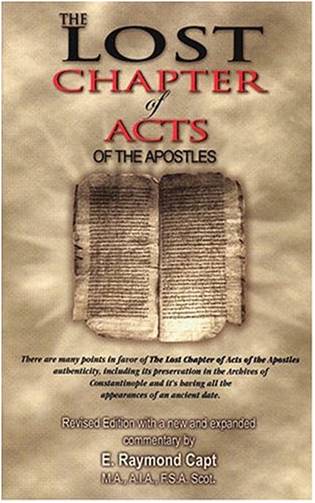
I started by providing a little context to the texts with a discussion of the canonical Acts, noting, among other things, the text’s depiction of Simon Magus and its abrupt ending with Paul in Rome. This led to a brief look at two modern apocrypha: the 29th Chapter of Acts and the Long-lost Second Book of Acts. Both continue Paul’s missionary work, either in Britain or in Palestine, and give the authors’ opportunity to …

Continue Reading

Christian Apocrypha Sessions for the 2018 SBL Annual Meeting

April 16, 2018 by Tony

The 2018 SBL Annual Meeting will have four sessions from the Christian Apocrypha Section. Dates, times, and locations will be announced later.

Session 1 (in conjunction with the Religious Competition in Late Antiquity)
Religious Competition in the Christian Apocrypha
Arthur Urbano, Providence College (Rhode Island), Presiding
Jacob A. Lollar, Florida State University: “What Has Ephesus to do with Edessa?: The Syriac History of John, the Cult of the Dea Syria, and Religious Competition in Fourth-Century Syria”
Jung Choi, North Carolina Wesleyan College: “Two Bodily Practices in the Acts of Peter”
Shaily Shashikant Patel, Virginia Polytechnic Institute and State University: “Magic and Polysemy: The Case of the Pseudo-Clementines”
Christopher A. Frilingos, Michigan State University: “Blood Into Stone: Violence, Sanctuary, and ‘Jewish Christianity’ in the Protevangelium Jacobi”
Lily Vuong, Central Washington University, Respondent

Session 2
New and Neglected Christian Apocryphal Texts
Tobias Nicklas, Universität Regensburg, Presiding
Chance Bonar, Harvard University: “An Introduction to 3 Apocryphal Apocalypse of John”
Florentina Badalanova Geller, Freie Universität Berlin: “Apocryphal Gospels and the Folk Bible”
Tony Burke, York University: “Opera Evangelica: The Discovery of a Lost Collection of Christian Apocrypha”
Bradley Rice, McGill University: “The Suspension of Time in the Book of the Nativity of the Savior”
James E. Walters, Rochester College: “The (Syriac) Exhortation of Peter: A New Addition to the Petrine Apocryphal Tradition” (20 min)

Session 3
Sex and Violence in the Christian Apocrypha
Janet Spittler, University of Virginia, Presiding
Catherine Playoust, University of Divinity:
“‘And …

Continue Reading

2018 New Testament Apocrypha Course: Week 7

March 1, 2018 by Tony

Our second week looking at resurrection texts focused on apocalypses. We began with a short reading from the beginning of the Apocalypse of Paul with its claim to have been found, along with a dusty pair of shoes, in a chest in the home of Paul in Tarsus. We have seen such claims before in the Coptic Pseudo-apostolic memoirs. It’s a curious feature: for all orthodox Christianity’s bluster about apocryphal texts being fakes and forgeries, many orthodox writers had little hesitation in creating some of their own apocryphal texts to serve their own purposes. The look at this introduction served as a lead-in to the conventions of apocalyptic literature, including, as in Apoc. Paul, the motif of hiding a book away and rediscovering it centuries later when all of its prophecies appear to have come to pass.

After a brief discussion of the canonical Book of Revelation, we spent a short time looking at several apocryphal apocalypses of John. The first of these, usually called 1 Apocryphal Apocalypse of John, continues the story in Revelation with John asking additional questions of Jesus, this time about the form that the dead will take when they rise from the grave: as thirty-year-olds and bodiless, without any distinguishing features (shape, size, colour). Another text, the Questions of James to John,  features James asking John questions about redemption. Simon Peter and Mary Magdalene are presented as examples of people who had committed grave sins yet they repented and achieved salvation. Mary, …

Continue Reading

2018 New Testament Apocrypha Course: Week 6

February 17, 2018 by Tony

Our first of two classes on Passion and resurrection gospels began and ended with the Gospel of Mary. We read the conclusion to Gos. Mary as a group and I had the class consider who the Mary of the text is (the Marys tend to blur in apocryphal traditions), why the apostles doubt her vision (did the author anticipate resistance to the text’s “strange teachings”?), and what to make of the interplay between Peter and Mary (a microcosm of orthodox and “heretical” group conflicts?).

We carried this discussion of orthodoxy and heresy into our discussion of the next text examined this week: the Revelation of Peter. As a Nag Hammadi text, Rev. Peter is not usually discussed among Passion gospels, but it is set during the crucifixion of Jesus. Its docetic Christology—i.e., the divine Christ only “seemed” to be human, and departed the body of Jesus of Nazareth at the crucifixion—makes Rev. Peter one of the most controversial texts among the Christian Apocrypha and elicited much discussion from the class. We followed up Rev. Peter with a look at other texts that share the crucifixion-substitution motif, including Irenaeus’s description of the teaching of Basilides, the Second Treatise of the Great Seth, the Acts of John, the Qur’an (Sura 4.157), and the Gospel of Barnabas. To supplement this survey of literature we looked also at a segment from the documentary Secret Lives of Jesus focusing on Basilides and Rev. Peter.

The Gospel of Barnabas’s

…
Continue Reading

Posts pagination

  • Previous
  • 1
  • 2
  • 3
  • 4
  • 5
  • 6
  • 7
  • 8
  • …
  • 38
  • Next
Twitter feed is not available at the moment.

Archives

  • February 2026
  • November 2025
  • August 2025
  • July 2025
  • June 2025
  • May 2025
  • April 2025
  • March 2025
  • February 2025
  • January 2025
  • December 2024
  • November 2024
  • October 2024
  • September 2024
  • November 2023
  • October 2023
  • May 2023
  • February 2023
  • December 2022
  • November 2022
  • October 2022
  • January 2022
  • November 2021
  • August 2021
  • May 2021
  • December 2020
  • November 2020
  • October 2020
  • August 2020
  • July 2020
  • May 2020
  • April 2020
  • December 2019
  • November 2019
  • October 2019
  • July 2019
  • June 2019
  • February 2019
  • December 2018
  • November 2018
  • October 2018
  • September 2018
  • August 2018
  • July 2018
  • May 2018
  • April 2018
  • March 2018
  • February 2018
  • January 2018
  • December 2017
  • November 2017
  • October 2017
  • September 2017
  • August 2017
  • June 2017
  • May 2017
  • April 2017
  • March 2017
  • January 2017
  • December 2016
  • November 2016
  • October 2016
  • September 2016
  • June 2016
  • May 2016
  • March 2016
  • February 2016
  • January 2016
  • November 2015
  • October 2015
  • September 2015
  • August 2015
  • July 2015
  • June 2015
  • May 2015
  • April 2015
  • March 2015
  • February 2015
  • January 2015
  • December 2014
  • November 2014
  • October 2014
  • September 2014
  • August 2014
  • July 2014
  • June 2014
  • May 2014
  • April 2014
  • March 2014
  • February 2014
  • January 2014
  • December 2013
  • November 2013
  • October 2013
  • September 2013
  • August 2013
  • July 2013
  • June 2013
  • May 2013
  • April 2013
  • March 2013
  • February 2013
  • January 2013
  • December 2012
  • November 2012
  • October 2012
  • September 2012
  • August 2012
  • July 2012
  • June 2012
  • May 2012
  • April 2012
  • March 2012
  • February 2012
  • January 2012
  • December 2011
  • November 2011
  • October 2011
  • September 2011
  • August 2011
  • June 2011
  • May 2011
  • April 2011
  • March 2011
  • February 2011
  • January 2011
  • December 2010
  • November 2010
  • October 2010
  • September 2010
  • August 2010
  • July 2010
  • June 2010
  • May 2010
  • April 2010
  • March 2010
  • January 2010
  • December 2009
  • November 2009
  • June 2009
  • May 2009
  • December 2008
  • November 2008
  • October 2008
  • August 2008
  • July 2008
  • May 2008
  • April 2008
  • March 2008
  • February 2008
  • November 2007
  • October 2007
  • September 2007
  • August 2007
  • July 2007
  • June 2007
  • May 2007
  • April 2007
  • March 2007
  • February 2007
  • January 2007
  • December 2006
  • November 2006

Categories

  • 2007 Apocrypha Workshop
  • 2010 Acts of Pilate workshop
  • 2013 CSBS
  • 2014 CSBS/CSPS
  • 2015 Gnosticism Course
  • 2018 NTA Course
  • 2020 BASONOVA lecture
  • Abgar Correspondence
  • Acts of Philip
  • Acts of Thomas
  • Acts of Titus
  • AELAC
  • After Jesus
  • Anchor Yale Bible Reference Library
  • Anne Rice
  • Anti-CA Apologetic
  • Apocalypse of Peter
  • Apocalypses of John
  • Apocrypha Collections
  • Apocrypha Journal
  • Apocryphal Acts of the Apostles
  • Apocryphal Gospels
  • Apostolic Lists
  • Armenian Apocrypha
  • Art
  • Assumption/Dormition
  • Bart Ehrman
  • Beyond Canon
  • Bible Hunters
  • Bible Secrets Revealed
  • Biblical Archaeology Review
  • Birth of Jesus
  • Book of the Rolls
  • Book Reviews
  • CA in Ancient Libraries
  • CA sites
  • CA Web Sites
  • Call for Papers
  • Canon Formation
  • Christ Files
  • Christian Apocrypha
  • Church Slavonic
  • CNN Finding Jesus
  • Conferences
  • CSBS/CSPS Christian Apocrypha
  • Da Vinci Code
  • Death of Judas by Papias
  • Defining apocrypha
  • Deir a-Surian Monastry
  • Dialogue of the Paralytic with Christ
  • Dissertations
  • Doctrine of Addai
  • Dormition of the Virgin
  • ECA Series
  • Encomium 12 Apostles
  • Erasure History 2011
  • Erotapokriseis
  • Ethiopic Apocrypha
  • Expository Times Volume
  • Fabricating Jesus
  • Forgotten Gospels
  • Francois Bovon
  • Funeral of Jesus
  • Gnosticism
  • Gospel Fragments
  • Gospel of Jesus' Wife
  • Gospel of Judas
  • Gospel of Mary
  • Gospel of Nicodemus
  • Gospel of Peter
  • Gospel of the Savior
  • Gospel of the Twelve Apostles
  • Gospel of Thomas
  • Gregory of Tours
  • HMML
  • Hospitality of Dysmas
  • Infancy Gospel of Thomas
  • Infancy Gospels
  • Inventing Christianity Series
  • Irish Apocrypha
  • Jesus in Egypt
  • Jesus Tomb
  • Jewish-Christian Gospels
  • John the Baptist
  • Joseph and Aseneth
  • Judas Apocryphon
  • Letter of Lentulus
  • Letter to the Laodiceans
  • Life of John the Baptist
  • manuscripts
  • Many Faces of Christ
  • Martyrium of Cornelius
  • Material of Christian Apocrypha
  • Medieval Apocrypha
  • Modern Apocrypha
  • Montreal Conference
  • More New Testament Apocrypha
  • MOTP
  • Nag Hammadi Library
  • NASSCAL
  • NASSCAL Conferences
  • nativity story
  • Old Testament Pseudepigrapha
  • On-line CA books
  • Ottawa Workshop
  • Oxford Handbook of Early Christian Apocrypha
  • Paul and Resurrection
  • Pilate Cycle
  • Pilgrimage
  • Protoevangelium of James
  • Ps.-Cyril on the Passion
  • Pseudo-Memoirs of the Apostles
  • Rediscovering Apocryphal Continent
  • Regensburg
  • Revelation of the Magi
  • SBL Christian Apocrypha Section
  • Schoyen gospel
  • Secret Lives of Jesus
  • Secret Mark
  • Secret Scriptures Revealed
  • Slavonic Apocrypha
  • Studies in Christian Apocrypha
  • Sybilline Oracles
  • Syriac
  • Syriac Life of Mary
  • Tabloid Apocrypha
  • The Aquarian Gospel
  • The Carpenter's Son
  • The Halo Effect
  • The Lost Years
  • The Messiah
  • Tischendorf
  • Uncategorized
  • Vatican Passion gospel fragment
  • Wedgewood
  • Women
  • York Christian Apocrypha
© 2026 Apocryphicity | WordPress Theme by Superbthemes