Book Review: The Lost Novel of King Solomon and the Demons
 Artifacts related to Christian Apocrypha are exciting to discover. In them we see how apocryphal traditions are applied outside of or alongside the texts and get a sense of their impact on people’s lives. So it was a pleasure to be given the opportunity to read Ittai Gradel and Nils Arne Pedersen’s new book, The Lost Novel of King Solomon and the Demons: New Evidence on the Testament of Solomon in Antiquity (full disclosure: a copy was sent to me for review). Not only does it feature a discussion of ten rings related to TSol but also an argument for using them to determine the text’s original form, function, and authorship.
First, what is the Testament of Solomon? It is an Old Testament Pseudepigraphon extant in 26 Greek manuscripts (at last count). It was first published from a sixteenth-century manuscript (Paris, Bibliothèque nationale de France, gr. 38; = P) by Ferdinand Florens Fleck in 1837. An English translation by F. C. Conybeare followed in 1898. Additional manuscripts were made known and a new edition created by C. C. McCown in 1922. The edition is eclectic (drawing on various manuscripts) but is based primarily on another sixteenth-century witness (Oxford, Bodleian Library, Holkham gr. 82; = H). McCown’s edition has become the standard resource on the text and was used for Dennis C. Duling’s translation in James Charlesworth’s Old Testament Pseudepigrapha (1:935–87).
In McCown’s edition, the text opens with Solomon as he works on constructing his temple (1–2). The master workman’s son is plagued by a demon, Ornias, who take half of the boy’s wages and provisions. Each day the demon sucks the thumb of the boy’s right hand. Noticing that the boy has grown thin, Solomon learns from the boy what has been happening to him. Solomon goes into the temple and begs God for the demon to be delivered into his hands. In response, Michael brings him a ring with a seal engraved on a precious stone. The ring gives him the power to imprison all demons and command them to build his temple. Solomon gives the boy his ring and tells him to fling it at the demon’s chest, say “Come! Solomon summons you!” and then run to Solomon. The demon follows the boy to Solomon and is made to confess his name, what Zodiac sign he resides under, and which angel thwarts him. Then Solomon seals the demon with his seal and orders him to cut stones for the temple. At first he resists, so Solomon calls upon Ouriel, his thwarting angel, for aid. Solomon also commands Ornias to bring him other demons, which Ornias does using the ring and the same command, “Come! Solomon summons you!” As each of the demons appears, Solomon has them identify themselves, the type of harm they perform, and the angel that thwarts them (1–15). This first section concludes with Solomon saying he wrote this testament and gave it to the sons of Israel so they would know the demons and how to combat them.
But the text continues with additional demons (16–17), including a lengthy list of the 36 heavenly bodies (18). Then follows a series of legends: various kings and the Queen of Sheba contribute materials for the temple (19), an old man asks for help against his violent son but Ornias informs Solomon that the man is the villain and will kill his son (20), the Queen of Sheba tours the temple (21), the king of Arabia asks Solomon for help against a wind demon (and it is imprisoned in a flask with the help of Solomon’s ring; 22), the wind demon and the demon of the Red Sea bring a pillar from the Red Sea and to this day they hold it up in the temple (23–25), and Solomon builds temple of idols in order to satisfy his Shummanite bride (26). As a result the glory of God departs from Solomon. The text finishes with a second statement from Solomon about writing his testament.
As with other OT Pseudepigrapha, scholars debate whether TSol is a Jewish or Christian composition. There are a number of Christian features in the text, including several prophecies about Jesus told by the demons (12; 15:7–12; 17). It is possible that these are Christian additions to an originally Jewish text, but Gradel and Pedersen argue that TSol is a Christian composition and note where it draws upon NT texts (the Synoptics, Ephesians, and 1 Peter).
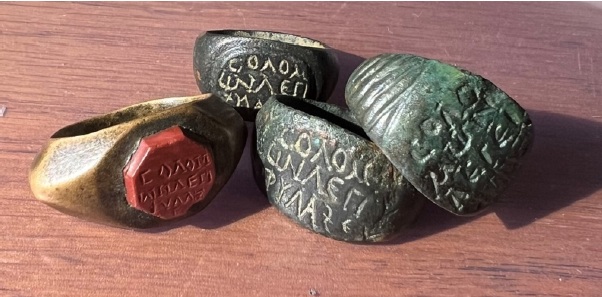 So where do the rings come in? There are ten rings in all, five published here for the first time (catalog of rings ch. 3; photographs pp. 23–25). All are datable to the first half of the third century. Six are very similar to one another and perhaps were manufactured at the same workshop, even by the same person. Two bear Christian symbols: one with two fish, the other with a fish and an anchor. The most prominent feature, however, is a Greek inscription: “Solomon says, ‘Watch out’” (one has the past tense: Solomon said). The ring seems to be related to two episodes from the text. The first is the story of the demon Ornias sucking the boy’s thumb. A ring would be an ideal apotropaic object of protection from such a creature. In TSol the ring also can be used to command and bind other demons. But the statement “watch out” appears only in the second related story, when Solomon seals the pillar with his ring and tells the demons to “watch out” (24:2) as they lift the pillar.
Most significantly, Gradel and Pedersen see the rings’ use of the present tense (“Solomon says”) as proof that TSol was not originally a “testament” (told in first-person and in the past tense) at all, but a narrative (third person, present tense)—this is their “lost novel.” This is precisely the style of the earliest manuscript (Vatican, Biblioteca Apostolica Vaticana, Vat. gr. 1700, dated 1332–1333; =G), though it is incomplete. Other manuscripts vary in first and third-person rather inconsistently. Gradel and Pedersen argue that the original text was third-person throughout. This original text they call Proto-TSol; a later editor changed it to the testamentary genre, which requires first-person narration. Furthermore, the list of the 36 heavenly bodies is characterized as a secondary addition made in the fourth or fifth century (pp. 78–79); the tale of the demon Enepsigos (15:8–12) is also considered an interpolation (pp. 178–86).
Grade and Pedersen have no kind words about the redactional process that led to TSol:
We therefore argue, employing the rings to take Nordheim’s analysis further, that the original version of TSol was not a testament at all, but a novel with Solomon as its main protagonist. This lost novel, narrated in the third person, we term Proto-TSol, argue that it was both longer, better narrated, and of far greater literary merit than TSol, which represents a secondary, testamentary epitome of the original novel. The editorial hack responsible for this abridged testament version had neither narrative talent nor much imagination: he abbreviated according to his own interests, but did not substantially change the narrative. His interest was in demonological aspects rather than in the story as such, and consequently the storyline in his epitome version is frequently obscure or even senseless. (188)
The authors spare no praise, however, for the original text, which they imagine was “more suave, more logical, more sophisticated” (p. 69) and in places “much better, racier, longer, and more coherent” (p. 71).
Among the implications of the authors’ position is that the current critical edition by McCown and the translation by Duling are inadequate. Gradel and Pedersen consider manuscript P a better representative of the text (albeit in testamentary form) and include in their appendix Conybeare’s translation. Also included are translations of G, D (a “late and secondary revision” but also told in the third-person), E (a modern Greek text also in the third-person), and the first full translation of a story similar to TSol 20 (derived, the authors say, from Proto-TSol) in the Syriac Obsequies of the Virgin 20 (accompanied by an edition and manuscript photographs). These texts are all quite welcome, but what would be more useful is a new edition and translation that could replace McCown (which Gradel and Pedersen concede is “sorely needed,” p. 55). And while on the topic of manuscripts and textual criticism, it is unfortunate that the authors do not present a clear description of the manuscripts early in the book. Their history of scholarship (pp. 5–22) uses sigla that are not explained until pp. 53–55, and even then most of the information is compressed into footnotes. A list of the sigla in the opening pages would be an easy remedy to this problem.
Another implication is that the rings indicate a third-century Christian context for at least the dissemination and popular use of the text. Coupled with the obvious Christian elements in TSol, it seems pretty secure that this is indeed a Christian composition from a fairly early period (“at least the second century,” p. 61). Gradel and Pedersen are pushing too far, however, in suggesting that the text and rings originated in the same place and community (p. 51), which the authors suggest to be Alexandria (pp. 168–72).
The Lost Novel includes also a chapter on Solomonic lore from Jewish sources, including Josephus’ description of his command of demons for healing and exorcisms (Ant. 8.2.5.45–49), which includes a tale of Solomon using a ring to dispel a demon, and the story of Solomon and Ashmedai from the Talmud (presented here pp. 130–33) in which Solomon uses a ring and a chain inscribed with the divine name to force demons to build the temple. These are noteworthy parallels, but they are minimized by Gradel and Pedersen in their efforts to prove that TSol is a Christian composition. This is more extensively argued in the following chapter, which discusses also negative reactions from Justin Martyr, Origen, and Eusebius on the use of Solomon’s name for coercing demons. Despite such criticisms, pilgrims in the fourth and fifth centuries write about seeing the ring of Solomon on display in Jerusalem. In an epilogue, Gradel and Pedersen mention the incorporation of Solomonic demon-fighting lore in the Qur’an, Muslim folktales (including two tales in The Arabian Nights) and iconography; this use continues up to today in apotropaic symbols and amulets referring to Solomon and his ring.
Gradel and Pedersen have made an important contribution to the study of TSol. While The Lost Novel has a few idiosyncrasies (most notably the juxtaposition of the literary qualities of Proto-TSol and TSol), it is carefully argued and clearly written. I think the arguments for an early novelistic account of Solomon and the demons could be made without appeal to the rings, but they are a fascinating example of the interplay between apocryphal texts and material culture.
The Testament of Solomon is one of the few works to provide a list of angels names so little ackowlegded today – do demons arouse more interest than angels…