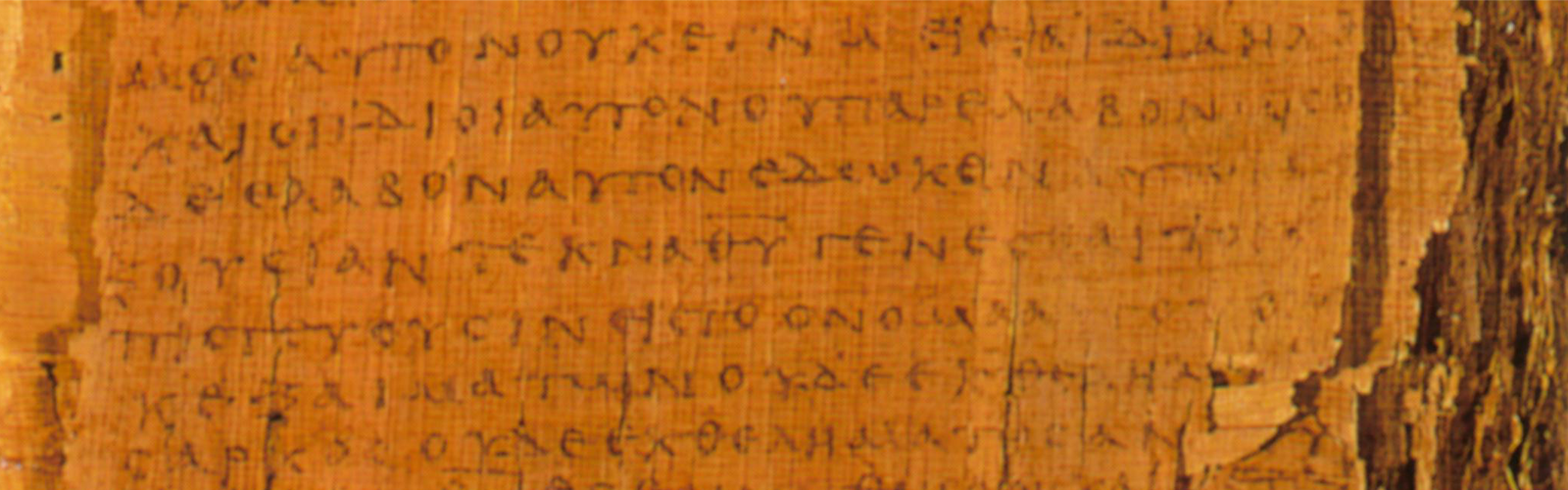
Panel on Secret Mark
Chris Zeichmann over at Thoughts on Antiquity (HERE) has posted a summary of a panel discussion of Secret Mark that took place at Claremont Graduate School last week (February 28). Among the panelists were Marvin Meyer, John Dart, Birger Pearson, and Dennis MacDonald.
Dear Dr. Burke
Thank you for this information regarding Secret Mark. I have many questions regarding Secret Mark. Here are just a few: Do you personally think its a forgery? Was Morton Smith a prominent scholar before this discovery? If so, what did he have to gain from producing a forgery? Finally, does the
Mar Saba letter Clement of Alexandria match the style of other letters attributed to him.
ok so i guess accusations that he had a forger’s tremor cannot be proven, but I think that because the actual letter is lost, and cannot be tested or looked at places a lot of doubt on its authenticity. also, i hear that the photos that smith took of this letter supposedly show his initials on the bottom of the page. the fact that smith also threatens to sue other scholars kind of shows me that he’s trying a little to hard to protect his name, possibly because he knows its a forgery and that he did such a bad job at it that his scheme has been found out.
I also find it interesting that smith seems to have based his interpretation the character Salome on Oscar Wilde’s play of the same name. doesn’t this also place great doubt on its authenticity, and his interpretation?
Matt: I have yet to be convinced it’s a forgery. All of the evidence adduced by Carlson is circumstantial and several of his points have also been effectively challenged. Carlson is no text critic. His model of forgery does not apply to texts like this (put quickly, a “forger’s tremor” shows evidence that a person has copied his work from something; of course he has! this is not the autograph of the letter [i.e.,not Clement’s original], but a copy made by somebody else). Even if I think it is not a forgery, that doesn’t mean I think “Secret” Mark was the original Mark as some claim. Yes Smith was a prominent scholar before the forgery but a bit of a maverick and not very well-liked by others. All he had to gain was to jerk people around (so this would be a hoax rather than a forgery) which apparently was in his personality to do. And yes, the letter bears the marks of typical Clement style, but this could be easily faked (indeed a concordance to Clement’s works came out shortly before this, making it that much easier to copy his style). You should get a copy of Carlson’s book; it’s cheap and a good read.
Bahram: I haven’t heard about initials on the photo and I don’t have the photos here with me. I also haven’t heard the comment on Salome. As for why sue, doing so would only bring more scrutiny to the issue, which I think a forger would try to avoid.
in the 6th paragraph of the link provided, it talks about smith’s interpretation of the ‘gay gospel’, it states, “Additionally, Smith’s interpretation of the character Salome appears to have been based on Oscar Wilde’s play of the same name, referring to the seven veils”
i checked up on the claim i saw that his initials were on the bottom of the secret gospel……..and it doesn’t seem like a credible source, so we can forget about that accusation.
I always used to say that of course it is a forgery; the debate is when it was forged and who did it…
I have seen Smith’s original photographs of the Clement letter, both published and unpublished, and he did not leave his initials on the bottom of the pages in the Voss edition containing the Clement letter. What he did do, however, was leave his last name and his catalogue number on each book that he catalogued at Mar Saba. Therefore, in the Voss book, he wrote Smith 65 on the upper right hand corner of the first page recto. The Clement letter appears on the end pages that follow page 365. I have seen photographs of other books he catologued at Mar Saba, and he did this on each book he catalogued, not just the Voss edition. Thus, a grain of truth enters the realm of folklore.
David, how do you categorize a text as a “forgery”? Some might say the deutero-Paulines and Pastorals are forgeries. Do you simply mean the letter is not by Clement of Alexendria? Or Secret Mark is not by the author of canonical Mark?
Bahram, the article is summarizing the views of Peter Jeffery and states “Additionally, Smith’s interpretation of the character Salome appears to have been based on Oscar Wilde’s play of the same name, referring to the seven veils.” (For more on Jeffery’s views select the Secret Mark tab from the menu on your left). Not having been there, and so relying only on the summary, all I can say about this is that Jeffery is referring to Morton Smith’s interpretation of the gospel, not the text itself (it does not mention anything about seven veils; indeed, all it says about Salome is the character’s name). So, this is not an anachronism that indicts the gospel as a forgery.
Actually the letter does speak of “the adyton of the seven-veiled truth” in a similar way that Clement elsewhere speaks of “the adyton of the truth…which the Hebrews signified by the veil” of the temple. However, the letter doesn’t speak of the seven veiled truth in the same context as Salome. According to Smith’s understanding, Salome was a rare figure in early Christian literature, appearing chiefly in Clement, Origen, and Egyptian pseudepigrapha, and he believed that her mention in the letter was further evidence of its Egyptian origin and favored attribution to Clement.
Allan, thanks. My assumption was that the seven-veiled Salome was being adduced as evidence for the forgery of Sec. Mark. This is not in the Sec. Mark passages, but I didn’t think that it might be in the letter itself.
Yes, the seven veiled truth is mentioned in the body of the letter, while Salome is mentioned in one of the Sec. Mark passages. Getting from here to Oscar Wilde requires some rhetorical acrobatics, but I suppose any two disconnected points can be connected by someone determined enough to do it.
Heh heh. Not too much love for Peter Jeffery, huh Allan?
This may be a bit of a naive question, but why would a scholar create a forgery? Is it just to improve their own reputation, because I would assume most scholars would have a love and respect for the material if they’ve spent their whole life interpreting it.
Cheers,
Joshua
Dear Dr. Burke
Who do you think the “young man” in the Gospel of Mark is? Perhaps Mark, John, or the actual writer of the Gospel? Is the narraive simply symbolic (e.g., the disciples are fully exposed as deserters of Christ)?
Joshua, Smith was apparently a bit of a character. Carlson discusses some motives, but many people have said that Smith had the genius to pull it off and the temperament to want to.
Matt, hmmm…two questions on the young man. Do you have an assignment on this? The “young man” is quite a mystery, and apparently Matt and Luke had enough of a problem with him to eliminate him from their gospels (or so Synoptic theory goes). Viewing the character from within the confines of the gospel’s own narrative world, I would have to eliminate John (there’s no reason to identify him with John unless you wished to harmonize the NT gospels), and if by Mark you mean the gospel’s author I’d also have to say no (“Mark” is not well-versed in Palestinian geography and Jewish practice, so it is unlikely he was part of Jesus’ group). It’s generally held that he is the young man in the tomb (who is not an angel). Given the interest in Mark in discipleship, I’d guess the character is symbolic for the ideal disciple who remained loyal to Jesus.