SBL Diary Day Three: The Birth of ACTA
Day 3: November 24
The last of four Christian Apocrypha sessions began at 9 am. This was another “open” session, without any particular guiding theme, though we gave it the title “The Cultural Context(s) of the Christian Apocrypha.”
The first paper was read by Petri Luomanen (University of Helsinki): “Judaism and anti-Judaism in the Protoevangelium of James, the Infancy Gospel of Thomas and the Gospel of Pseudo-Matthew.” As often happens, Luomanen’s paper was somewhat changed from his proposal: he eliminated Infancy Thomas from his study. He contrasted the overall positive portrayal of Jewish people and culture in Prot. Jas. (e.g., Salome the midwife doubts the virgin birth but she is instrumental for its proof; the “two people” of Mary’s vision in 17:2 are believers and non-believers) with its parallel material in Ps.-Matt. 11-16, where Judaism is seen negatively or simply removed from the narrative (e.g., the “two people” are Jews and Christians). Overall, Luomanen’s paper did not add much to the discussion of Judaism in Prot. Jas., a connection which is becoming increasingly acknowledged by scholars of the text.
The second paper was presented by Eugenia Constantinou (University of San Diego): “Holy of Holies! The Amazing and Impossible Life of Mary as told in the Apocrypha of the Christian East.” To the surprise of several of us in the room, Constantinou came across as somewhat hostile to apocryphal literature. Her aim was to show that the elements from Prot. Jas. incorporated into the Greek Orthodox liturgy, hymns, and iconography do not indicate value for the text in which they are contained. She remarked that Christians of the East are not as interested in where theological ideas come from as Christians in the West and that the presence of apocryphal motifs in iconography are important for their meaning, not their “history”—i.e., just because the motifs appear in an icon does not mean that they were believed to have happened. To demonstrate her point, Contantinou showed the audience an icon of the crucifixion and pointed out the various elements of the image that illustrate theological concepts; however, I think the example failed to help her argument, as Eastern Christians certainly believe in the historicity of the crucifixion. Furthermore, the liturgical readings from the saints would indicate that Greek Orthodoxy is interested in where stories originated. Of interest also in Constantinou’s presentation was the images she included of the conception of Mary; these show Anna and Joachim in front of a bed, indicating, contrary to readings in many of the Prot. Jas. manuscripts that there was nothing miraculous about Mary’s conception.
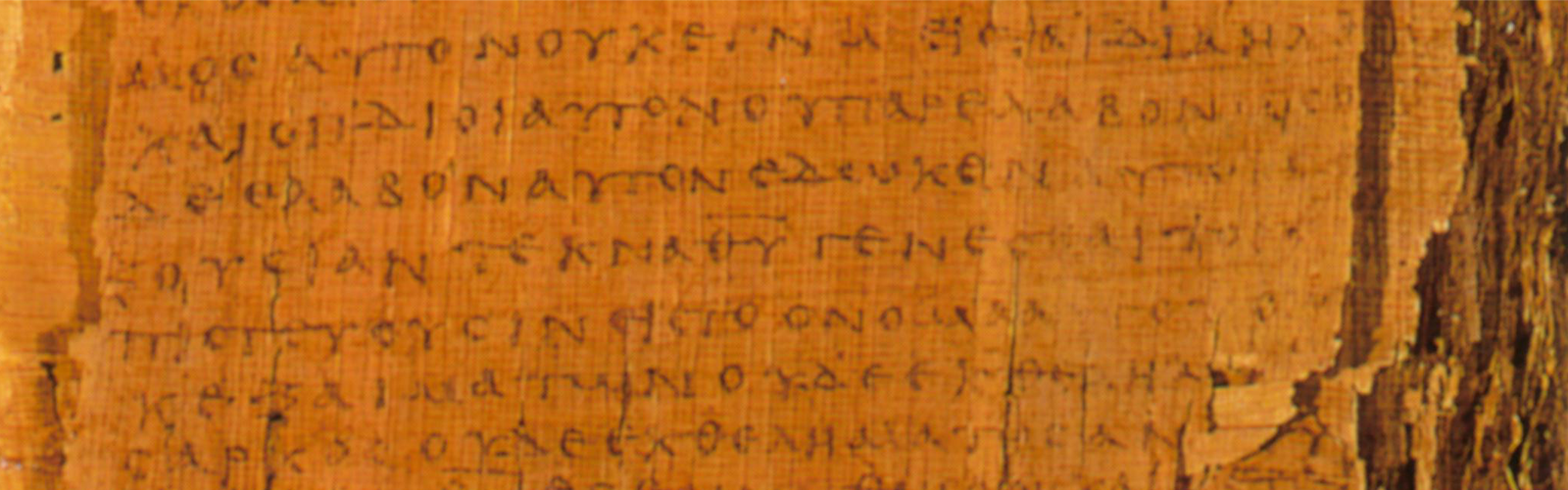
The audience at the session was far more receptive of Lorne R. Zelyck and Joseph Sanzo’s (University of Alberta) paper: “What is P.Berol. 11710: Amulet, Apocryphal Gospel, Biblical Elaboration?” This tiny manuscript (measuring 6.5 x 7.5 cm) has never been included in Christian Apocrypha collections; it has some features that indicate it was a miniature worn as an amulet, including holes on the edge that could have been used for a string and similarities to magical papyri (including charaktêres and a distinctive nomen sacrum). In the end Zelyck and Sanzo concluded that the text on the manuscript is not an apocryphal tale of Jesus but merely “improvised biblical tradition” blending John 1:29 and 1:49.
The theme of magic continued into Dominique Côté’s (University of Ottawa) “Magic, Necromancy, and Theurgy in the Pseudo-Clementines.” Typically Ps.-Clem.’s portrayal of Simon Magus has been seen as a thinly-veiled polemic against the apostle Paul, but Côté sees Simon instead as a composite character (reflecting Marcionism, Simonianism, and theurgy) used to denounce views and practices condemned in the 3rd/4th century.
The final paper of the session re-examined the debate over the authenticity of Secret Mark. In “More Evidence Origen Wrote To Theodore,” Michael Zeddies (University of Michigan-Ann Arbor) argued against the view that Clement of Alexandria wrote the letter containing the Secret Mark fragments. One of the principle arguments against Clement’s authorship is the letter’s statement that one should lie under oath, something that Clement does not support in his other writings. But Zeddies believes that the letter has been misattributed, something that happens often in patristic literature (try looking up the works of John Chrysostom to get a sense of the scope of the problem). The confusion is understandable: Origen was much influenced by Clement, and they both wrote a text named “Stromateis” (indeed, ancient writers characterized Origen’s text as an imitation of Clement’s). Zeddies provided an extensive list of Origenian features in the letter, but the most dramatic is that Origen actually had a student named Theodore. Zeddies finished his presentation with an excursus on the robe (sindon) worn by the young man in the Secret Mark fragments; he said that this simple robe worn over the naked body would be the appropriate dress for philosophical learning in one’s own home. The paper was the highlight of the session and I look forward to seeing the reaction to it once it is published.
Much of my afternoon was spent away from the hubbub of the meeting site (a little sight-seeing is permissible, right?). I returned early in the evening for the inaugural meeting of the Apocryphal Christian Texts Association (ACTA). The creation of this group came as a result of discussion at the close of the 2013 York Christian Apocrypha Symposium. There was interest in creating a scholarly association based in North America with the goal, primarily, of encouraging interaction between scholars of the literature. It would function as sort of a North American version of the French/Swiss Association pour l’étude de la littérature apocryphe chrétienne (AELAC). The meeting comprised all of the members of our 12-person founding board available at the SBL: me, Brent Landau, Bradley Rice, Stanley Jones, and Janet Spittler. We discussed the goals of the group for the next year—primarily building up a membership, assembling an executive structure and by-laws, establishing relationships with other societies, building up the group’s online presence—and considered possible future publishing endeavours. More news about the group will follow shortly. Stay tuned.
With the meeting concluded, my remaining stay in San Diego was devoted to sampling more of what the city had to offer tourists, including the San Diego Zoo, Old Town, and a failed whale-watching excursion (sadly, no whales to be seen; just one or two lonely dolphins). Then I dragged my wife back to the cold of Toronto and got back to work. Now, finally, this long-delayed account of SBL 2014 is concluded; thanks for hanging in there.
Very excited to hear about the creation of the ACTA! Looking forward to hearing more about it soon.
The paper by Michael Zeddies does sound interesting. Thanks for the summary, and please let us know when it’s published.
Here’s a question, for starters. Does Zeddies consider that the student Theodore was later (at baptism) named Gregory? (The Gregory sometime known as Thaumaturgos?) Or were they two different people? If the former, would Origen write such a letter to Theodore before baptism? In other words, would Origen address him, afterward, as Gregory?
Hi Stephen–thanks for asking. This is a point I didn’t address during my talk, but have of course considered. I take Nautin’s view that Theodore and Gregory were different persons. (I also take it that the /Panegyric/ should be attributed to Theodore, so I guess I think it has been misattributed to Gregory, but I don’t find this important.)
However, I don’t find it very problematic if Theodore and Gregory are to be identified. McGuckin says only that he “probably” took the name Gregory at baptism (/Westminster Handbook/ p. 16 n. 84). I’m not aware of any source besides speculation that proposes this was a baptismal name, but I’m happy to be educated on this point.
Sorry for making a comment so late, but I cannot resist asking a question about the interesting theory from Michael Zeddies about “To Theodore.”
It has to do with Bethany —- Origen was responsible for popularizing the view that Bethany of Judea is the only true Bethany and the Bethany beyond the Jordan mentioned in John 1:28 is really “Bethabara.”
Yet “Secret Mark” seems to take for granted the existence of two Bethanys, as shown by its placement of the youth’s Bethany resurrection in chapter 10 of Mark, which takes place “in the borders of Jerusalem and beyond the Jordan” (Mark 10:1) instead of ch. 11, which takes place around Jerusalem (including the better known Bethany near Jerusalem). The resurrection sequence in Secret Mark concludes with “he returned to the other side of the Jordan,” confirming that the location must have been beyond the Jordan. If Origen wrote the “To Theodore” letter, it would seem as though he overlooked evidence for the existence Bethany-beyond-the-Jordan in Secret Mark. This seems rather odd, given how precise the writer of “To Theodore” was in stating where in Mark the “Secret” fragments belong. Did Zeddies attempt to deal with this problem?
I don’t deal with this problem in my papers, basically because it merits its own paper and so far there hasn’t been room. But I have put some thought into it.
I agree that the intent of Secret Mark’s author was to place the Bethany resurrection on the eastern side of the Jordan, making it equivalent to John’s “Bethany beyond the Jordan”. Scott Brown has written on this:
http://www.academia.edu/4604827/Bethany_beyond_the_Jordan_John_1_28_and_the_Longer_Gospel_of_Mark
My guess is that Origen would nevertheless have interpreted “Bethany” in Secret Mark to mean the other Bethany, the one near Bethphage and the Mount of Olives. Thus to “return to the other side of the Jordan” would simply mean to return to the eastern side of the Jordan, where Mk 10:1 says he went (“beyond the Jordan”).
I can’t see that Origen would have found it troubling to have Jesus travel from beyond the Jordan to Bethany-near-Bethphage, then back again beyond the Jordan. It’s no more troubling than the path “through Sidon to the sea of Galilee” in Mk 7:31.