Reflections on the Material of Christian Apocrypha Conference: Part I
The “Material of Christian Apocrypha” conference took place at the University of Virginia in Charlottesville November 30 and December 1, 2018 (see the conference web site HERE). The event also doubled as the first meeting of the North American Society for the Study of Christian Apocryphal Literature (NASSCAL). It was organized by Janet Spittler (at the time Vice-President of NASSCAL) and her UVA colleague Fotini Kondyli. I have been asked by the editors of the journal Apocrypha to write a report on the conference. This blog post, and another to follow, are draft work towards completing that report but the posts will have a bit of a personal focus, highlighting what I found to be of interest to my own research and teaching interests. Many of the participants are active Twitter users, tweeting before, during, and after the event. Janet helpfully combined all of their efforts at this Wakelet compilation.
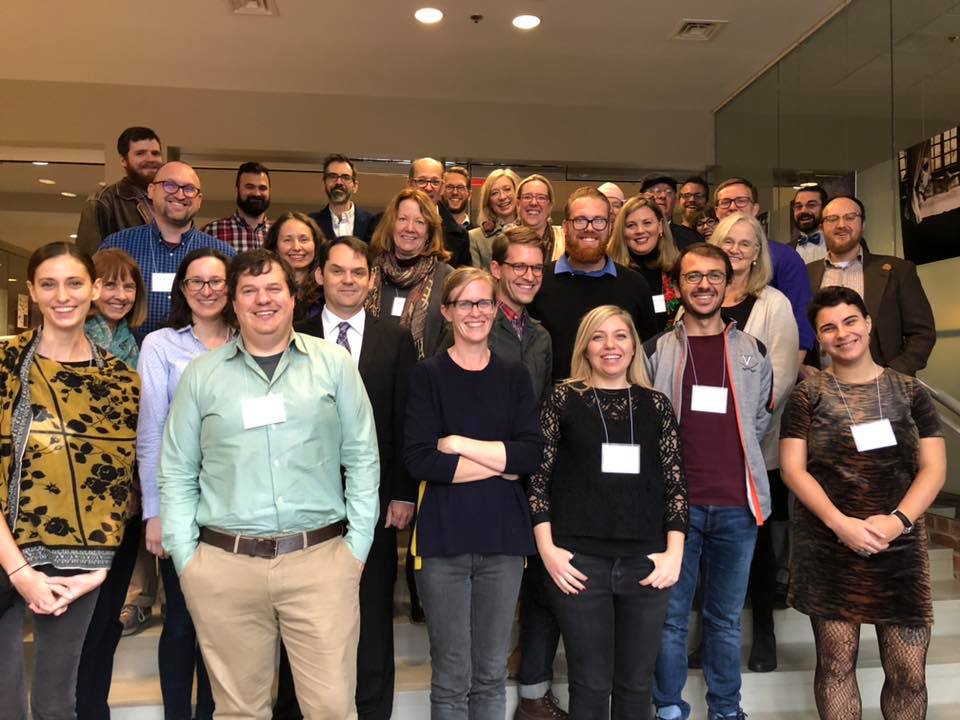
To start, I have to compliment Janet and Fotini on organizing a truly excellent and rewarding conference. I learned something from every paper. For past conferences (for SBL or the York Symposia), we have often considered visual topics—such as art, illuminations, and iconography—but have not been successful in attracting enough participants who work in the area. But the theme of this gathering was expansive enough to make it work and allowed for a broad range of approaches and conversation between scholars not only of Christian apocrypha, but also Medievalists, Byzantinists, scholars who work on Syriac and Coptic literature, and creators of Digital Humanities resources. The participants ranged from senior scholars to graduate students and it was gratifying to see how much the students seemed to enjoy and benefit from their interactions with each other and with the established scholars. As Janet said on several occasions, we’re a friendly bunch and that makes these gatherings and the collaborations that come from them enjoyable for everyone.
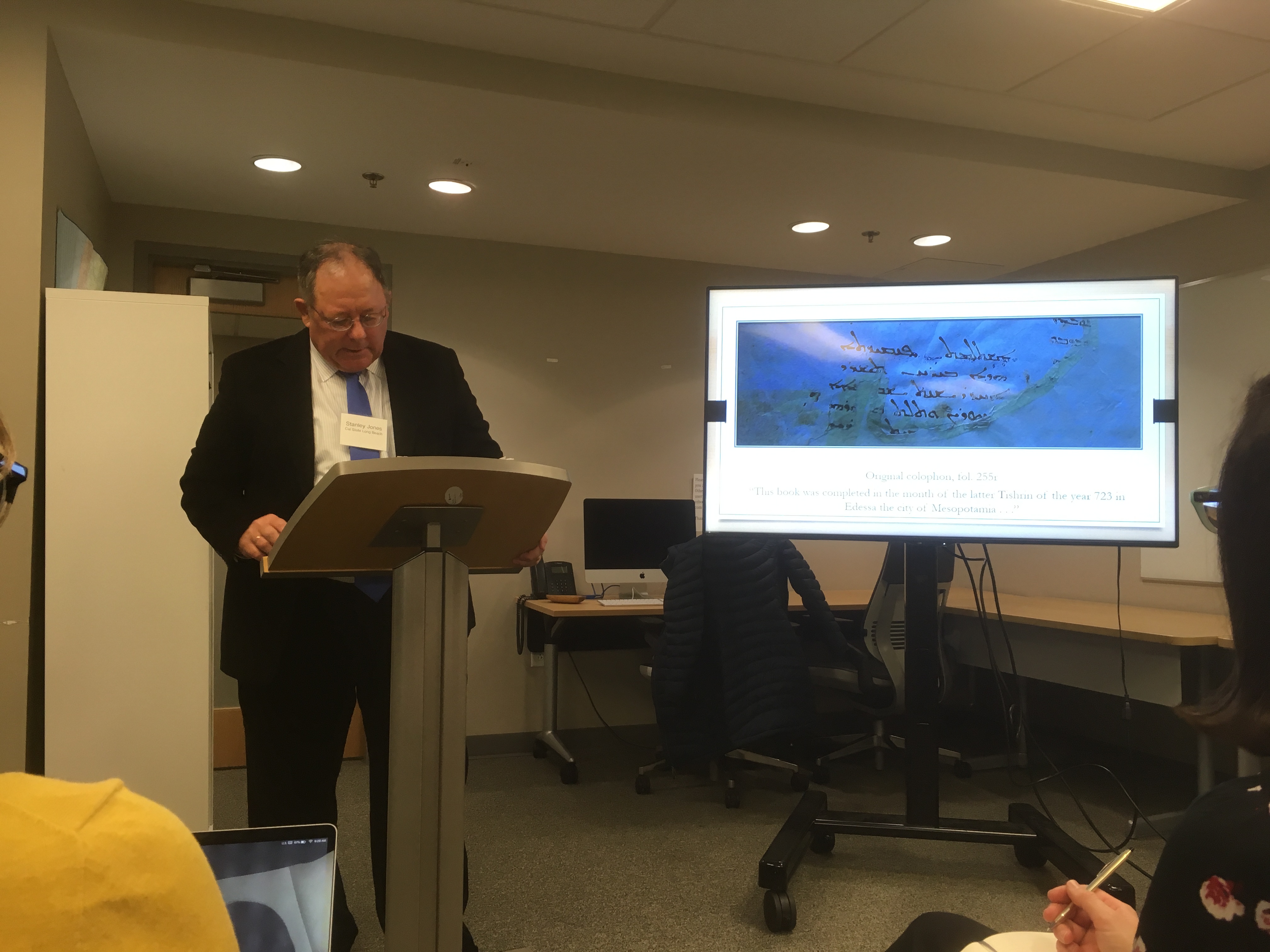
The first session of day one focused on manuscripts as material artifacts—essentially a new philology approach to text-criticism that focuses on each manuscript as its own particular version of a text worthy of study. Stanley Jones (California State University Long Beach) presented first with “Apocrypha in the World’s Oldest Dated Book.” This book is British Library Add. 12150, which was created, according to its colophon, in Edessa in 411 CE. It is exceptionally well-preserved but, alas, not yet digitized. It contains three major works—Titus of Bostra, Against the Manicheans; Eusebius, On the Theophany; and portions of the Pseudo-Clementines from two different manuscripts—and finishes with three shorter texts: Eusebius’s History of the Martyrs of Palestine and Encomium on the Christian Martyrs, and a martyrology. Jones sees a certain unity in the book, with Titus and Ps.-Clem. both having an anti-heretical focus, while Eusebius’s interest is doctrinal (though Ps.-Clem. also has doctrinal aspects), and the other three works are “martyrological anchors for the correctness of the doctrines” presented in the first several texts. Jones remarked that apocrypha scholars need to pay more attention to polemical aspects of apocrypha—the authors “weren’t just a bunch of idiots writing wild stuff,” he said. Jones spent some time in his presentation tracing the origins of the book (a school or scriptorium, perhaps commissioned from a professional scribe) and its journey from Edessa to the Syrian monastery (Deir al-Surian) in Wadi Natrum (Egypt), where it was removed for the British Library by Henry Tatum in 1839. Likely the book was brought to the monastery by Moses of Nisibis in 932. I have a particular interest in these manuscripts, having worked with two of them in the past: Add. 14484 (6th cent.), which contains a sixth-century Life of Mary collection (Protevangelium of James, Infancy Gospel of Thomas, and the Assumption of the Virgin) and the Six-Books Dormition of the Virgin, and Add. 17202 (ca. 570), featuring the Chronicle of Pseudo-Zacharias Rhetor, which incorporates Joseph and Aseneth. I have also done some work on ancient libraries (for a forthcoming memorial volume for François Bovon) and think it would be an interesting exercise to get a sense of which apocryphal works were available in the library of Edessa in the fifth and sixth centuries, and even expand that to future centuries leading up to the time of Moses’ journey to Egypt. I wonder too if there are connections between the library of Edessa and St. Catherine’s monastery in the Sinai, as two other fifth/sixth-century Syriac manuscripts of the Life of Mary collection derive from there.
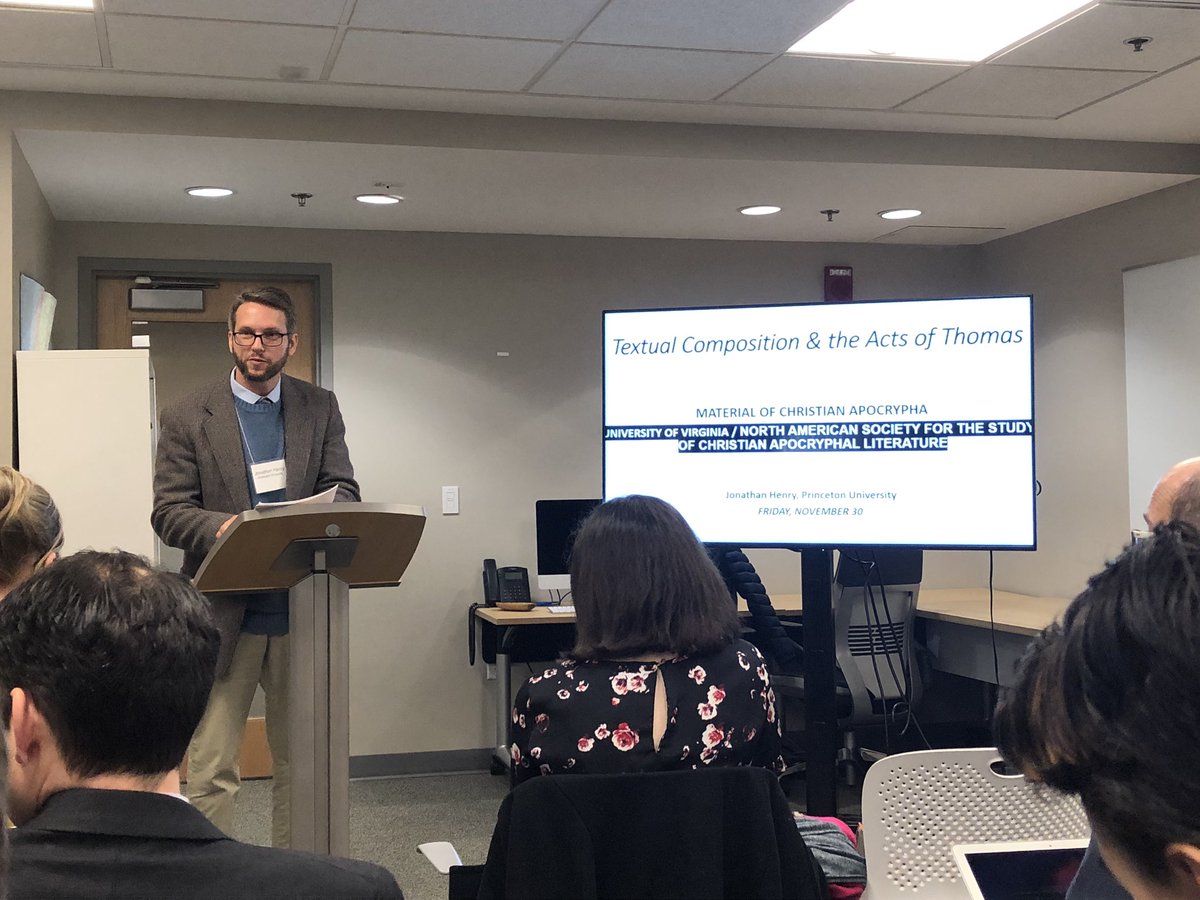
Jonathan Henry (a doctoral student at Princeton University) is working on the Acts of Thomas for his dissertation and I have seen him present on the text several times now (mentioned HERE and HERE). In his presentation “Textual Composition and the Acts of Thomas,” Henry reiterated his position that editions of texts like Acts Thom. obscure the history of these texts, reducing (substantial) variations to the apparatus where few readers will notice them. We are left with a text, philologists will say, that “never existed.” But a focus on the many different versions of a text can be a distraction from the completion of a manageable research project. Henry advocates some kind of reasonable balance, between appreciating each iteration of the text and using the evidence at hand to resolve a particular problem in the text’s history. For this particular paper, Henry seeks to do two things: “to envision (1) what the text was like as it circulated and came together in its various forms, and (2) how the process worked.” But he doesn’t leave behind the individual versions and asks what their variants tell us about what we call the Acts of Thomas. For example, the Hymn of the Pearl appears in only one Greek and one Syriac copy of the text—it seems “irresponsible,” he says, to call the hymn part of Acts Thom., but equally irresponsible to say that it is not (and in the notes to his paper, Henry says we consider the impact of printed editions for solidifying the authoritative version of a text). Also buried in his notes is an insight Henry has presented previously, that for all the statements by heresiologists and scholars that Acts Thom. (and other apocrypha) were valued by such heretics as the Manicheans, our copies of many of these works come from orthodox contexts (e.g., nestled into codices featuring works by John Chrysostom, martyrologies, etc.). New philology can tell us more about the use of these texts than a “vocal minority” who maligned them. Henry offers a useful axiom: “Don’t ask a heresiologist to tell you something you can learn from a copyist.” Much of the remainder of the paper/presentation looks at Susan Meyers’ examination of the compositional structure of the text, which was entirely new to me. In Meyers’ hands, Acts Thom. becomes a text much like the Acts of Paul, with its weaving together of previously-independent stories (acts 1–2, 3–8, 9–12, 13, with 9–12 composed in Syriac and, in Henry’s words, “could be called ‘an addition to the text by a later scribe’”). To conclude, Henry calls for thinking about the transmission of Acts Thom. (and other texts) as “a bewildering host of distinct, yet related mushrooms emerging through the ground in different times, angles, and forms, but all part of the same basic mycelium.”
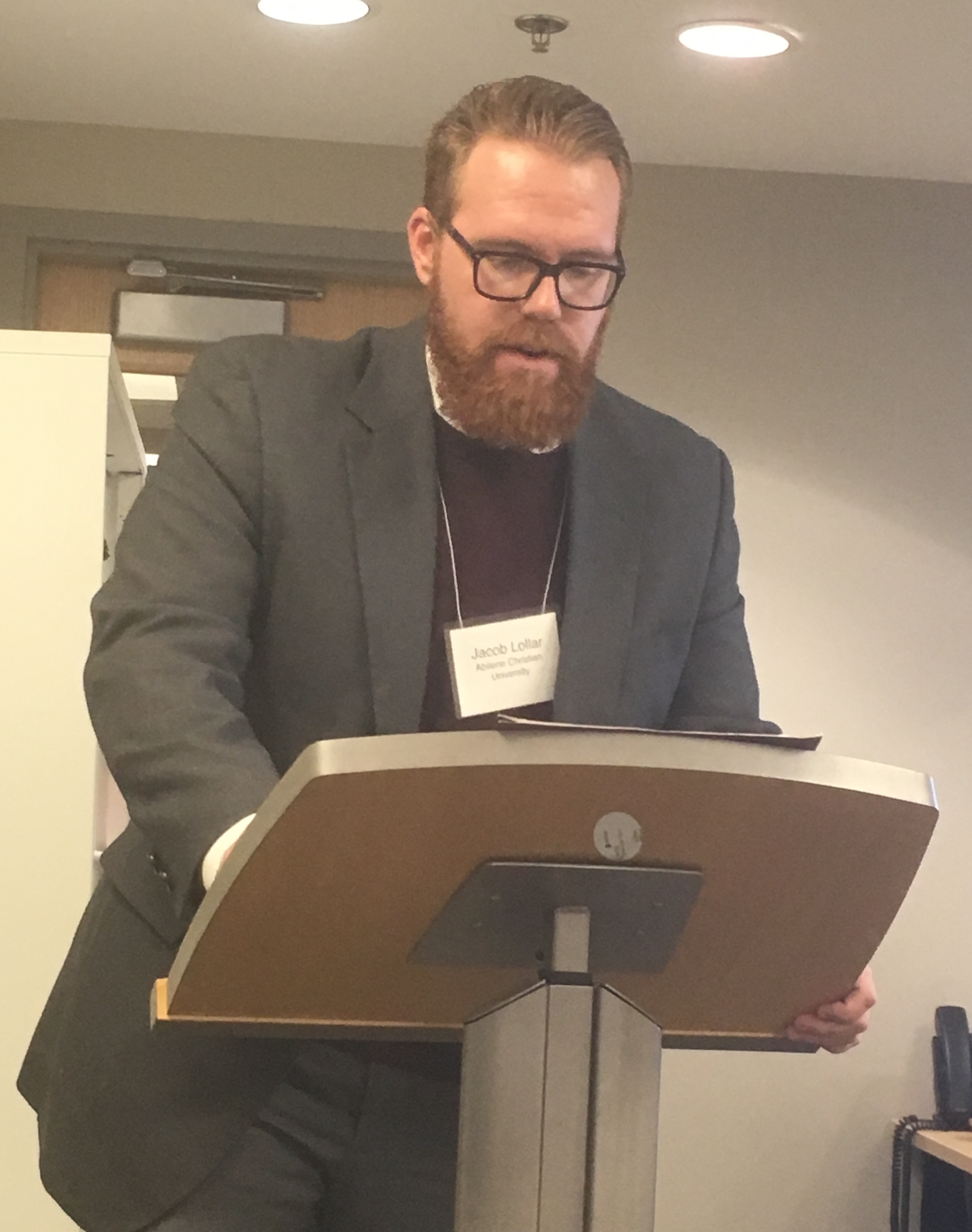
The final presenter in the session, Jacob Lollar (a recent graduate of Florida State University currently working on a post-doc at Abilene Christian University), has worked extensively with the History of John, another text found in Moses of Nisibis’s hoard, this time from a ninth century MS (Add. 17182). Hist. John is extant in Syriac and Arabic, but one of the Syriac MSS (St. Petersburg, Imperial Library, Syr. Ms 4) includes the claim that it was translated by Eusebius from Greek. R.H. Connolly argued for Syriac composition some time before the fifth century (“The Original Language of the Syriac Acts of John,” JTS 8 [30] [1907]: 249–61, available HERE). As evidence, Connolly cites, among other things, agreement in Gospel citations with the Peshitta (though some assimilation to the Vulgate text is to be expected), the use of certain phrases common to Syriac literature, and similarities with Acts Thom. in their descriptions of the baptism ritual. This is all germane to Lollar’s paper, “What Has Ephesus to do with Edessa? The Syriac History of John, Ephesus, and the Interface Between Textuality and Material Culture,” because it brings attention to a perplexing problem: Hist. John features a detailed description of Ephesus and its cult of Artemis, yet it appears to have been written in Edessa (as indicated not only by Syriac as its language of composition but also because the priests of Artemis refer to Edessa as Ephesus’s “sister city”). The “material culture” of this paper, then, is in its connection to a physical place. But what I found interesting about Lollar’s presentation was the collegiality shown by the other participants in trying to address the problem of why a Syriac writer knows so much about a Greek city. One solution is that Connolly is wrong—that the signs of Syriac composition are actually signs of Syriac translation (and I suggested that Lollar consult my work on the Infancy Gospel of Thomas, where I apply some methodology to the text to demonstrate that it is a Greek, not Syriac composition)—another, suggested by Fotini Kondyli, is to determine if the text’s description of Ephesus is from the perspective of a resident or a visitor.
The second session of the day featured two papers: Felicity Harley (Yale University) on “Visual Apocrypha: a Case Study from Early Christian Rome” and Stephen Hopkins (Indiana University) on “Bringing Life from a Whale Bone: The Franks Casket, Vindicta Salvatoris, and the Anglo-Saxon Supercessionary Hermeneutics.” Harley presented a number of visual representations of the Adoration of the Magi, a canonical tale (from Matt 2:1–12) but also recounted in several apocryphal infancy gospels. Harley’s argued that art can contain apocryphal aspects even if these elements cannot be correlated with a particular text. The ingredients in the representation can depend on several factors, including patristic and apocryphal texts and local sources, all filtered through the desires of the patron and the artist. Some of the more noteworthy variations are those that have more than three Magi (Catacomb of Domitilla in Rome and the Theusebios sarcophagus in Berlin), a flask at the Metropolitan Museum of Art that includes an angel leading the Magi (a motif found also in the Armenian Infancy Gospel), and a few other images in stone in which the Magi are accompanied by camels. Harley touched on a number of other issues, such as portrayals of Mary in a matron style typical of Roman art and juxtapositions of Mary flanked by the Magi with Jesus flanked by the apostles; of interest also were representations of stories from the Protevangelium of James, though I will have opportunity to mention these in connection with Robin Jensen’s talk later in the day.
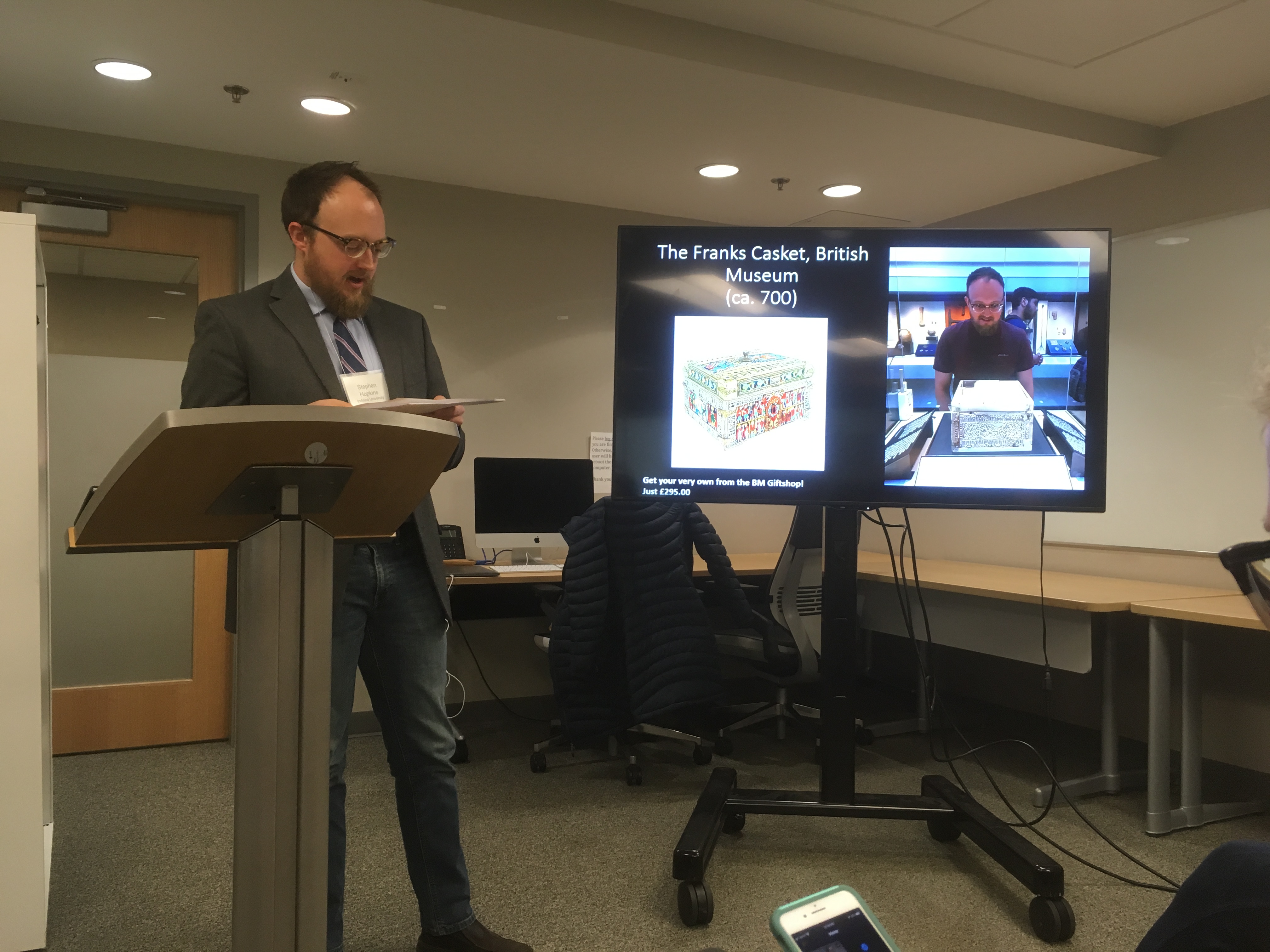
The object that was the focus of Hopkins’ presentation, the Franks Casket, was by far the most interesting artifact of the conference. It is a seventh or early eighth-century box carved out of whale bone that perhaps originally contained a Gospel book or Psalter; it is currently housed at the British Museum. The writing on it is a mixture of Latin and Anglo-Saxon runes. It features a number of scenes, including the Adoration of the Magi, Romulus and Remus, and some lost German myths. Hopkins’ focus, however, was on the back panel of the box, which depicts the siege of Jerusalem. There are two possible literary sources for this image: Rufinus’s translation of Eusebius’s Ecclesiastical History and the Vengeance of the Savior (Vindicta Salvatoris). Veng. Sav. was known in Anglo-Saxon England as late as the eleventh-century (the date of a vernacular translation appended to the Gospel of Nicodemus), but Rufinus seems the most likely source for the Casket, since it was a core history text for the Anglo-Saxons (for example, it was used extensively by Bede) and Veng. Sav. may post-date the artifact by a century (conversely, if the Casket does rely on Veng. Sav., then it would be the earliest witness to the text). Hopkins said he “really wanted it to be the case” that Veng. Sav. was the source of the image but he could not find anything in the depiction that tied it unequivocally to the text; nevertheless, the Casket could very well be associated with the text by someone with knowledge of Veng. Sav. who looked at the scene. Hopkins’ presentation was noteworthy also for bringing the Franks Casket into conversation with the Rufinus and Veng. Sav., since the three depictions of the siege are seldom discussed together.
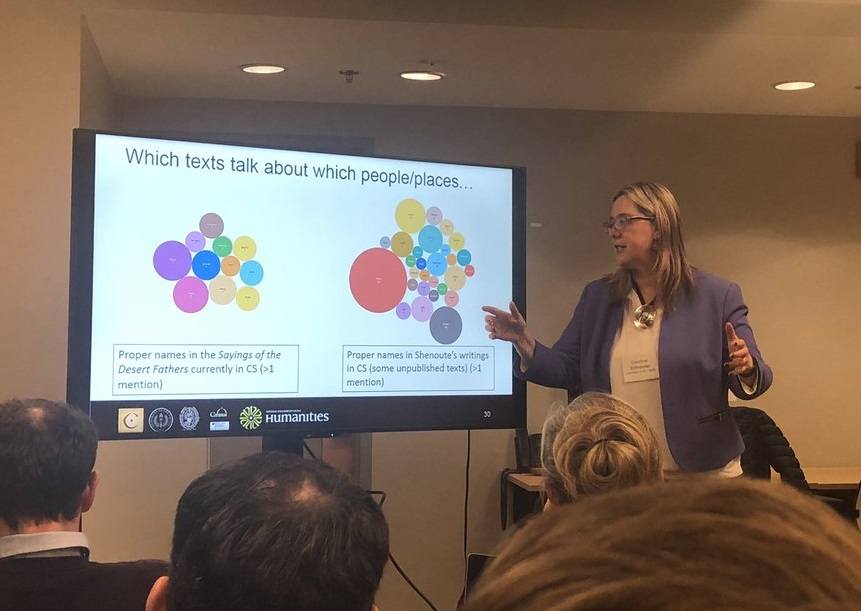
After lunch we moved our attention from the material culture of the medieval period to the intangible work of Digital Humanities scholarship in the modern age. Caroline Schroeder (University of the Pacific) was up first with “The Materiality of Digital Apocryphal Studies.” She asked three questions: “How can digital studies help us understand the material contexts of Christian apocrypha, especially manuscript culture? How can digital methods help us research material and embodied aspects of our text (topics such as space and gender)? How can digital apocryphal make interventions into public understandings of Christianity and culture?” To answer these questions, Schroeder presented some of the work of her project Coptic Scriptorium. Among other things, the site includes maps showing locations of digitized Coptic manuscripts—where they were created, where they are currently held, and another showing the paths leading from one to the other. It is an effective demonstration of colonialism in scholarship. Schroeder did similar magic on data from the e-Clavis Manuscripta apocryphorum, demonstrating the locations of the manuscripts and the variety of languages represented in the corpus. She noted too some of the strengths and weaknesses of the e-Clavis resource: at present it is a print source reproduced in a digital format, which makes it easier to maintain and is a low bar to entry but makes it difficult for computational research. She finished with a look at some other features of Coptic Scriptorium, including its sophisticated word search capabilities, and made an appeal to contribute time to enhancing and expanding the resource.
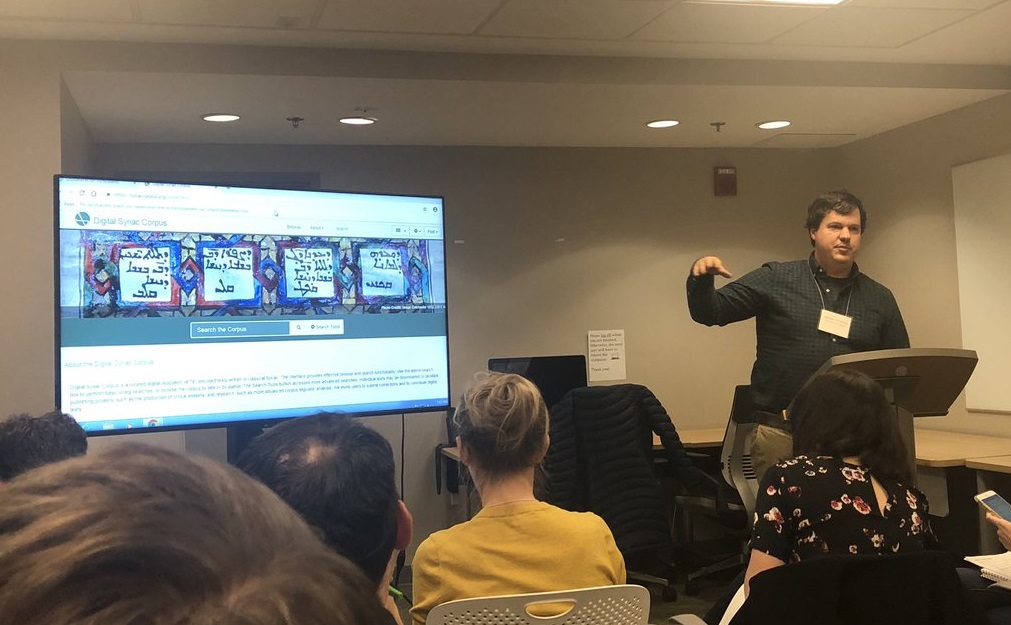
James Walters (Rochester College) then gave a presentation on his DH project: “The Digital Syriac Corpus: A New Resource for the Study of Syriac Texts.” Walters has presented several times now on this resource, most recently at the 2018 SBL Annual Meeting. The project began as a collaboration between David Taylor and Kristian Heal. They had a number of key texts transcribed from published editions; Walters joined the project in 2016 to make the material available to the public. The first text put on the site was a born-digital edition of the Exhortation of Peter, the translation of which will appear in vol. 2 of New Testament Apocrypha: More Noncanonical Scriptures. Walters gave a tour of the site and demonstrated its capabilities, including toggling between Syriac scripts and links between each word in a text to a dictionary entry from Beth Mardutho’s SEDRA (Syriac Electronic Data Research Archive)—which elicited oohs and ahs from the audience. Brandon Hawk (Rhode Island College) finished the session with “The Medieval Social Network of the Gospel of Pseudo-Matthew.” Hawk, who has produced a translation of the Pseudo-Matthew in the NASSCAL Early Christian Apocrypha series (which should debut in Spring 2019) and maintains the e-Clavis page on the text, is working to compile information on the 200 or so Ps.-Matt. manuscripts. So far, he has taken the best of these MSS and used Palladio to map connections between them, graphically demonstrating how they connect to one another through shared texts and provenance. Hawk sees this process as useful for texts with large bodies of MSS that cannot be mapped (at least not easily) by human means alone.
After seeing some of the possibilities presented by the panelists, I couldn’t help but feel my work creating NASSCAL’s e-Clavis was rather inadequate in comparison. The NASSCAL site is rather rudimentary and was put together for a mere $500 payment to a friend who cut us a deal. We have no funding, so all of the content is due to the kindness of our contributors. But next-to-no overhead also means no cost to users; the e-Clavis is proudly open-source. I am extremely happy that several of our new board members are gifted with more technological know-how than I and that with their help we can improve and expand the resource. In the session’s question period, Jacob Lollar asked about getting credit in hiring and promotion for doing DH work, which is a disincentive to contributing to these resources. I offered my usual advice: that collaborating on DH projects has residual benefits of connecting with scholars and getting one’s work known, but Schroeder offered more practical advice: write articles about your digital work. Janet Spittler added also that those of us who sit on hiring committees can encourage our colleagues to take DH work more seriously. A suggestion was made also for e-Clavis to send thank-you letters to our contributors that clearly state that their work for the site is refereed.
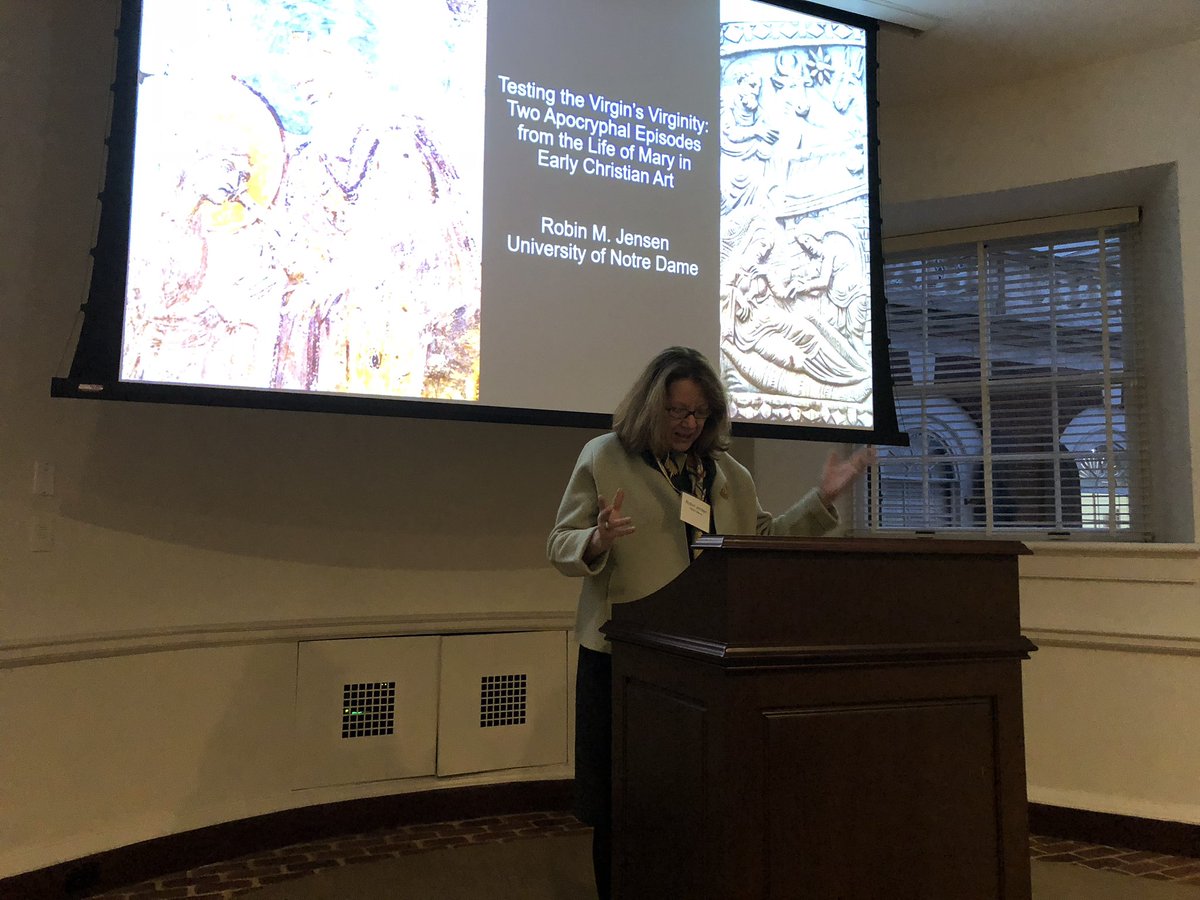
For the final paper of the day we moved to the Rotunda for Robin Jensen’s (Notre Dame University) extended presentation on “The Apocrypha and the Virgin Mary in Early Christian Art.” Jensen presented a survey of images derived from the Protevangelium of James, beginning with the annunciation to Mary, a canonical scene but drawing on motifs from Prot. Jas. These images brought us back to the Felicity Harley’s paper earlier in the day, which demonstrated the carefree blending of canonical and noncanonical motifs in art. The bulk of Jensen’s presentation focused on two scenes other scenes: the trial by water and the doubting midwife. The number of available representations of these scenes is surprising—including, but not limited to the Ivory Gospel Cover from the Treasury of the Milan Cathedral (5th cent.), the Werden Ivory Casket (6th-8th cent.) from the Victoria and Albert Museum, and an ivory panel (5/6th cent.) at the Louvre Museum, the cover of the Lupicin Gospels (6th cent.) at the Bibliothèque Nationale de France, the Etschmiadzin Gospel cover (6th cent.) from Armenia, the Cathedra of Bishop Maximian (ca. 550) at the Ravenna Archiepiscopal Museum, and several frescoes, including one in the Church of St. Mary in Castelseprio (9/10th cent.). Some of these sources also depict the midwife bathing Jesus, a motif that has no literary parallel—emphasizing once again that art and sculpture can be creators as well as conveyors of apocryphal traditions. The sheer number of the Prot. Jas. representations impressed upon me the need to spread awareness of their existence. Perhaps, following a suggestion made earlier in the day, e-Clavis should be expanded to include a “Materia apocryphorum” resource.
Day one of the conference finished with an informal dinner and drinks at Janet Spittler’s home. For the papers of day two, read “Reflections on the Material of Christian Apocrypha Conference: Part II.”